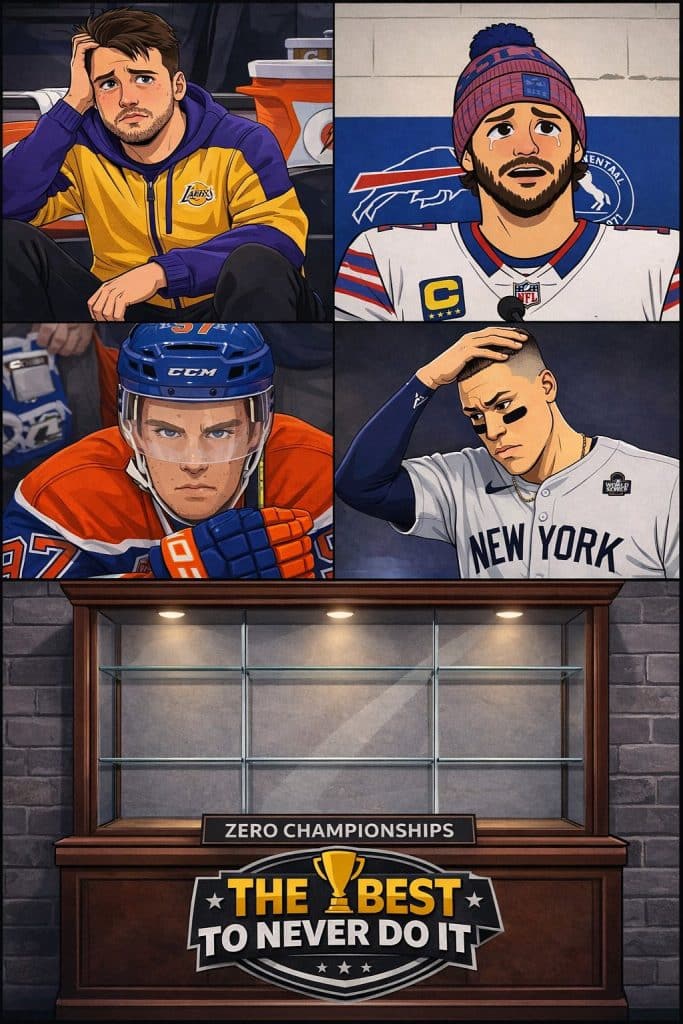
The Best to Never Do It: The Precedent Behind Josh Allen, Connor McDavid, Luka Doncic, and Aaron Judge Having Zero Championships in 2026


Do great players win championships in team sports, or do we determine players as great by winning championships? This kind of chicken-or-the-egg dilemma has existed for decades in sports, but it may only be getting amplified in an era where so many modern greats (Josh Allen, Connor McDavid, Luka Doncic, and Aaron Judge) are pushing 30 or have already gone past it while remaining ringless.
We looked earlier this week at the 36 NFL quarterbacks to win a Super Bowl and how the latest, Sam Darnold, stacks up. At least in the NFL in this era, the existence of Patrick Mahomes and the Chiefs can help explain why great quarterbacks like Josh Allen (turns 30 in May) and Lamar Jackson, both destined for the Hall of Fame, can’t even get to a Super Bowl, let alone win one. Darnold had to flee to the NFC with a No. 1 scoring defense to win his in a rare season where the Chiefs weren’t in the Super Bowl (or playoffs period).
In the MLB, baseball being such a turn-based game, a series of batter vs. pitcher matchups, can make it one of the hardest sports for any one player to win a championship. It doesn’t help that Aaron Judge, 34 in April, got a late start and was 25 after he won the Rookie of the Year award in 2017. But after 10 seasons, he’s just 0-1 in the World Series with the Yankees experiencing a title drought of 16 years.
In the NBA, we’re actually experiencing the second-longest streak of no repeat champions at seven years, which has allowed players like Anthony Davis, Giannis Antetokounmpo, Nikola Jokic, Jayson Tatum, and Shai Gilgeous-Alexander all to collect a ring while Luka Doncic (turns 27 this Saturday) waits his turn with the Lakers after the most shocking trade in NBA history not long after he led the Mavericks to a loss in the NBA Finals.
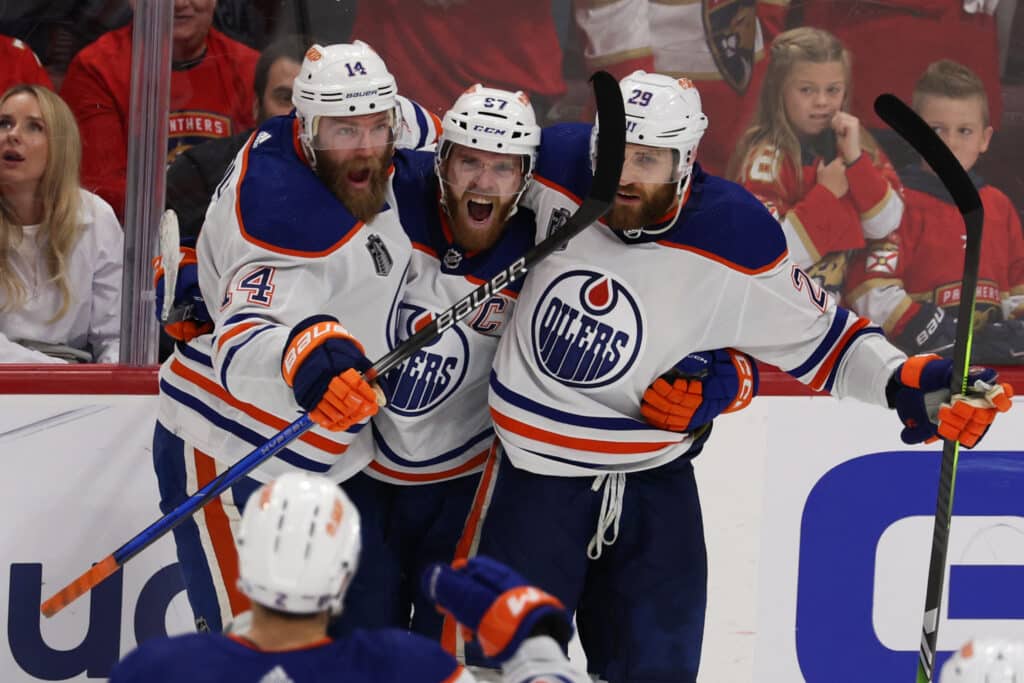
Then there’s Connor McDavid, 29, in the NHL who might be the most egregious case right now of a player without a championship as he skates in Year 11 for the Edmonton Oilers. McDavid is a 3-time MVP who is on track to lead the NHL in points for the sixth time in his career this season. Only 30 players have more playoff points than McDavid’s 150, but he’s lost the last two Stanley Cup Finals to the Florida Panthers.
Between Allen’s tear-filled press conference after losing to Denver and McDavid’s Team Canada coming up short against the USA in the 2026 Olympic gold medal game on Sunday, people have taken notice that we’re living through quite the period of top players without a ring to their resume.
But is this a historic group of ringless players, or have we seen this play out before? Another question is what’s the best group of players who never won a ring across the four major team sports in the US? That’s what we want to answer today.
Table of Contents
The Truth: Great Players Usually Do Win Championships
It’s really not that hard to reach the conclusion that great players do in fact usually win a championship in their career, even if their career overlaps with another great player. That’s why Kobe Bryant and Tim Duncan were both able to win five championships in the NBA in the period of 1999-2014. They finished their careers in 2016, the same season where LeBron James won his third championship.
As it turns out, being a great player with impressive statistics helps a team win a lot of games consistently, which leads to playoff appearances, which lead to chances at championships. Eventually, most are going to cash in on those chances for a ring or multiple rings.
So, if you throw a lot of touchdown passes, score a lot of goals, hit a lot of home runs, or score a lot of NBA points, chances are it’s going to lead to a championship at some point more often than it never happening.
This isn’t to say there is no element of time involved with building a championship team around even a generational talent. It took many of the game’s all-time greats more than a handful of years to win their first championship, including:
- Michael Jordan (Year 7)
- Mario Lemieux (Year 7)
- Peyton Manning (Year 9)
- LeBron James (Year 9)
- Alex Ovechkin (Year 13)
- John Elway (Year 15)
- Roger Clemens (Year 16)
- Alex Rodriguez (Year 16)
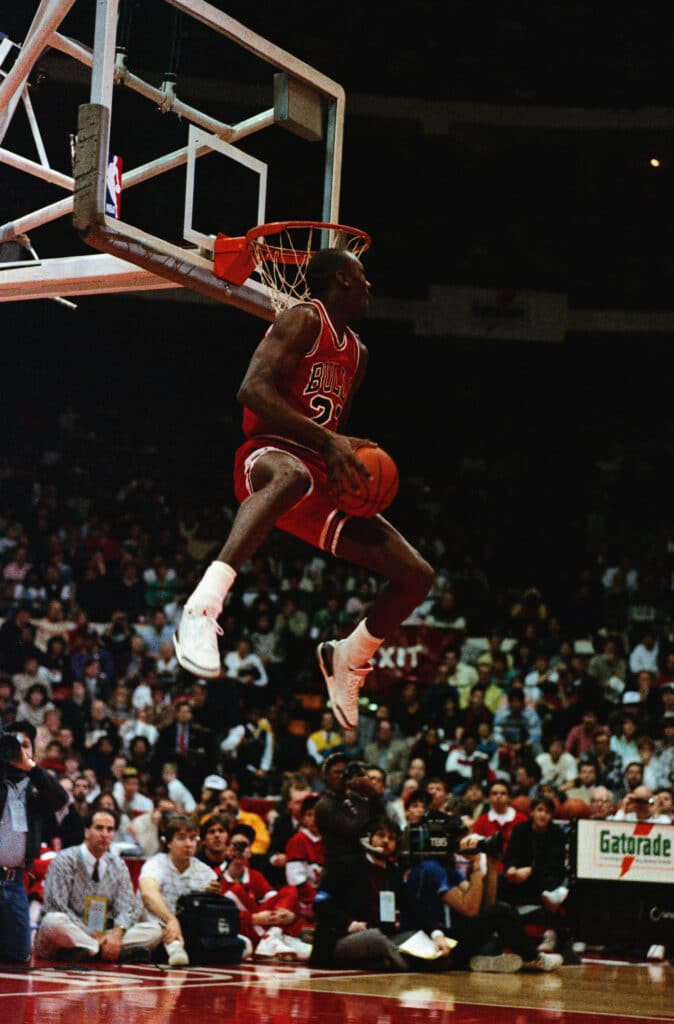
But there’s also a similar, longer list of all-time greats who won their first championship in quick fashion:
- Bill Russell (Year 1)
- Mickey Mantle (Year 1)
- Magic Johnson (Year 1)
- Babe Ruth (Year 2)
- Kareem Abdul-Jabbar (Year 2)
- Patrick Roy (Year 2)
- Tim Duncan (Year 2)
- Tom Brady (Year 2)
- Johnny Unitas (Year 3)
- Willie Mays (Year 3)
- Joe Montana (Year 3)
- Patrick Mahomes (Year 3)
- Gordie Howe (Year 4)
- Sidney Crosby (Year 4)
Of course, there are some all-time great players who never win a championship, including Dan Marino, Randy Moss, Barry Sanders, Barry Bonds, Ted Williams, Ken Griffey Jr., Charles Barkley, Elgin Baylor, Chris Paul (just retired), Marcel Dionne, and Jarome Iginla.
Those last two hockey names are a little underwhelming compared to the rest of the group, which is something we examined last year for McDavid in that the NHL has done a fantastic job of seeing most of the all-time greats hoist a Stanley Cup, making the drought for McDavid a little more worrisome.
But is it really that unusual for a great group of players to be ringless at the same time? Let’s dig into the history next.
The Best to Never Do It: The Best Players Without a Championship Since 1975
Let’s take a different approach to this than just listing the top 10 players in each sport to never win a championship or something we’ve seen before. Let’s go back a solid 50 years or so to 1975 to take a snapshot of each year in regards to who the best active player was who had yet to win a championship.
Why 1975? Beyond it being just over 50 years ago, it’s a good starting point for change in the four leagues that brought about a playoff format closer to what we see today. It’s also enough time past certain mergers and expansion eras that players had enough time to start accumulating championships.
- The 1975 NFL playoffs were the first year they used a seeding system to avoid oddities like the undefeated 1972 Dolphins playing the AFC Championship Game on the road at Pittsburgh (yes, that happened). It was also Year 10 of the Super Bowl era.
- The 1975 NBA playoffs were the first time the tournament was expanded to 10 teams to account for expansion and the start of the First Round.
- The 1975 NHL playoffs used a new re-seeding format instead of a fixed bracket where the highest remaining seed after each round was matched against the lowest remaining seed. The 1975-76 season is also just the ninth season after the NHL expanded from the “Original Six” era to have way more than just six teams competing for the Cup.
What we’re going to do in the following sections is look at the best player in the NFL, NBA, NHL, and MLB that year who did not have a championship ring at the time. Maybe they won one later, but they did not have one through that season yet.
In terms of the years, you have to read them this way. The entry “2025” will include the 2025 NFL season, the 2025 MLB season, and the 2025-26 NHL and NBA seasons that are still in progress. Should McDavid or Luka win a championship in the coming months, then they’ll obviously not count for 2025. But you have to count them this way since even the NFL season technically started in 2025 and ended in 2026. It’s the easiest way to make them on equal grounds.
With that said, greatness is subjective. The best player is subjective. I’m not going to get every single one of these 204 data judgments correct as some were so close that you could flip a coin between two or three players and live with the outcome. But I like to think I did the best job I could of coming up with the most accurate representation of the “best player without a championship at the time” for each year from 1975-2025, so let’s see what it looks like.
The last thing I’ll note is any player in a table with an asterisk next to their name means they won a championship later, and I only used quarterbacks for NFL since that’s the main position we always discuss when it comes to rings anyway. But any basketball player is fair game, and I included at least one pitcher and goalie in the MLB and NHL choices too.
1975-1983: The Great One
With more sports fans watching at home on their color television sets, sports were taking off as a business with pre-game shows and more pageantry. Before the 1980s brought an excess of scoring (and Cold War paranoia), the leagues were transitioning to more offensive games built for TV thanks in part to the arrival of hockey’s greatest player as well as the West Coast offense in football and an all-time rivalry begins in the NBA.
Here are the best players without a championship at the time for the period of 1975-1983:
| Year | NFL Best | NBA Best | NHL Best | MLB Best |
|---|---|---|---|---|
| 1975 | Fran Tarkenton | Bob McAdoo* | Marcel Dionne | Carl Yastrzemski |
| 1976 | Fran Tarkenton | Bob McAdoo* | Marcel Dionne | Carl Yastrzemski |
| 1977 | Fran Tarkenton | Bob McAdoo* | Marcel Dionne | Carl Yastrzemski |
| 1978 | Fran Tarkenton | George Gervin | Bryan Trottier* | Carl Yastrzemski |
| 1979 | Dan Fouts | George Gervin | Wayne Gretzky* | Carl Yastrzemski |
| 1980 | Dan Fouts | Moses Malone* | Wayne Gretzky* | George Brett* |
| 1981 | Dan Fouts | Moses Malone* | Wayne Gretzky* | George Brett* |
| 1982 | Dan Fouts | George Gervin | Wayne Gretzky* | George Brett* |
| 1983 | Dan Fouts | George Gervin | Wayne Gretzky* | George Brett* |
NFL
In the defense-heavy 1970s, quarterbacks like Roger Staubach, Bob Griese, and Terry Bradshaw already won Super Bowls, which often came at the expense of prolific scrambler and passer Fran Tarkenton, the first quarterback to throw 300 touchdown passes. The 35-year-old Tarkenton was 0-2 in the Super Bowl going into the 1975 season where he won MVP, but his team fell in the first playoff game to Staubach’s Cowboys after a controversial Hail Mary touchdown to Drew Pearson.
A year later in 1976, Tarkenton’s Vikings lost another Super Bowl to Ken Stabler and the Raiders, dropping him to 0-3 in the big game. He lost his last playoff game in 1978 before retiring, paving the way for Dan Fouts with the Chargers, who ran a dominant passing offense with great weapons known as “Air Coryell” that revolutionized the game at a time when the passing game really opened up thanks to rule changes in 1978 regarding illegal contact.
But Fouts and the Chargers would have little postseason luck on teams that usually had bad defenses, losing two AFC Championship Games, including the 1981 “Freezer Bowl” in frigid Cincinnati. Fouts even lost the 1982 MVP vote, 35-33, to a kicker (Mark Moseley) during a 5-year period where he led the NFL in passing yards per game every season.
But by 1984, a new passing savant was ready to take the league by storm. He too would never win a ring just as Tarkenton and Fouts never did.
NBA
We mentioned in the intro how the NBA has gone seven seasons without a repeat champion. But once Bill Russell’s Boston dynasty ended in 1969, the NBA had 17 straight seasons without a repeat champ in 1970-86 until the Lakers finally repeated in 1987-88. That meant plenty of titles to go around in the early 70s for Kareem Abdul-Jabbar (1971), Jerry West (1972), and Boston’s new star Dave Cowens (1974).

In 1975, Rick Barry won his only championship for the Warriors, or he might have been the choice here. Instead, we landed on Bob McAdoo, the HOFer who was the 1972-73 Rookie of the Year before he won three straight scoring titles in 1974-76. He also was the 1974-75 MVP and the MVP runner-up a year later. He played for the Buffalo Braves before they later became the Los Angeles Clippers.
But playoff success eluded McAdoo until he became a member of the Lakers in the 80s and won two rings that way as a contributor. That’s why we jumped ship to George Gervin, who had his own three-peat of scoring titles in 1978-80 for the Spurs. He never won a ring.
While the 1980s would become a battle of Lakers vs. Celtics (Magic vs. Bird) in the NBA, the early portion of that decade saw the 76ers as a major contender thanks to Moses Malone, the 3-time MVP who left Houston for Philadelphia and won his first championship in that 1982-83 season. That’s why the list reverts back to Gervin, who was about to be replaced by the phenom of the 80s.
NHL
When you talk about that 1975-76 season in the NHL, you’re getting into a wild era where the Montreal Canadiens (1976-79) and New York Islanders (1980-83) pulled off back-to-back four-peats. There weren’t many rings to go around back then, but one of the players who continues to show up in lists of the best to never win a Stanley Cup is prolific scorer Marcel Dionne, who retired with 731 goals and 1,040 assists, which still rank him sixth and 12th today.
Dionne won the Pearson award (known today as the Ted Lindsay Award for Most Outstanding Player as voted by the NHLPA) in 1978-79 and 1979-80. But he never won a Cup.
Bryan Trottier of the Islanders won the Hart (MVP) in 1978-79, but he only had to wait one more year before his four-peat run started, a reign that only ended a few wins shy of a five-peat thanks to the Edmonton Oilers in 1984, led by Wayne Gretzky.
But while “The Great One” may have been an instant success as a 19-year-old with 137 points and the first of his eight-straight Hart awards, he didn’t get over the hump in the playoffs with his star-studded teammates until that 1983-84 season before ripping off four Cup wins of their own in a 5-year period in 1984-88.
MLB
The 1975 World Series really proved to be pivotal in this as the Cincinnati Reds defeated the Boston Red Sox in Game 7, giving a first championship to hitting machine Pete Rose and 1975-76 MVP winner Joe Morgan. They also repeated in 1976. Had this gone the other way, maybe they’re the two to choose between here.
Instead, it’s Boston’s Carl Yastrzemski, the 1967 Triple Crown MVP who was an 18-time All-Star, but he came up 0-for-23 with Boston at winning a World Series, losing twice in 1967 and 1975.
But by 1980, Yastrzemski was 40 and past his prime. You had some new challengers for the title, and one was Kansas City’s George Brett, who won the 1980 AL MVP after batting .390. He finally won his first World Series in 1985 with the team, but Mike Schmidt (Phillies) won the World Series in 1980, so that’s why he’s not the choice here.
1984-1989: The Greatest Group
In the mid-to-late 1980s, fans were treated to some of the greatest offensive players they’ll ever see. But while they weren’t winning championships in this time, they’d be among the biggest winners in the 1990s.
Here are the best players without a championship at the time for the period of 1984-1989:
| Year | NFL Best | NBA Best | NHL Best | MLB Best |
|---|---|---|---|---|
| 1984 | Dan Marino | Michael Jordan* | Marcel Dionne | George Brett* |
| 1985 | Dan Marino | Michael Jordan* | Mario Lemieux* | Don Mattingly |
| 1986 | Dan Marino | Michael Jordan* | Mario Lemieux* | Roger Clemens* |
| 1987 | Dan Marino | Michael Jordan* | Mario Lemieux* | Roger Clemens* |
| 1988 | Dan Marino | Michael Jordan* | Mario Lemieux* | Roger Clemens* |
| 1989 | Dan Marino | Michael Jordan* | Mario Lemieux* | Roger Clemens* |
NFL
For as great as Dan Fouts was, Dan Marino had an even quicker release and was almost impossible to sack. You could see it right away when he threw 20 touchdown passes as a rookie despite not even throwing 300 total passes.

But in the 1984 season, Marino rewrote the NFL record books with 5,084 passing yards and 48 touchdown passes, two records that would last until 2004-08. He was an easy choice for MVP, but he had the misfortune of running into a 1-loss San Francisco team in what would be his only Super Bowl as the Dolphins lost big. Marino was the only quarterback to beat the 1985 Bears a year later, but we didn’t get to see that Super Bowl rematch because the Dolphins lost the AFC Championship Game at home to the Patriots in an upset.
Marino continued to be the most prolific passer in the game, but it was Montana who had the best support around him in the 80s, a theme that would carry over into the 90s with other quarterbacks as well.
NBA
In the 1984 NBA Draft, Michael Jordan may have only been the No. 3 pick, but he was an instant star, averaging 28.2 points per game and ranking No. 2 in PER as a rookie. After he was injured in Year 2, by his third season, Jordan averaged 37.1 points per game and won his first of 10 scoring titles.
In a decade dominated by Magic Johnson vs. Larry Bird, Jordan was the best player. But the Bulls weren’t ready for a championship run or to get past the Bad Boy Pistons until they got Jordan enough help with Scottie Pippen and coach Phil Jackson.

That’s why it wouldn’t be until the 1990-91 season when Jordan finally reached the NBA Finals and made short work of Magic’s Lakers to win his first of six championships.
NHL
At the same time Michael Jordan entered the NBA, Mario Lemieux was the No. 1 pick in the 1984 NHL Draft by the Pittsburgh Penguins. A worthy rival to Wayne Gretzky’s record-breaking stats, Super Mario lived up to the hype and scored 100 points in his rookie season. By Year 2, he had 141 points, more than any season Marcel Dionne ever had in his career.
Before you knew it, Lemieux had seasons where he scored 70 and 85 goals. But the Penguins weren’t going on deep playoff runs yet. Similar to Jordan’s Bulls, Lemieux needed help in the form of better coaching and another key player like Jaromir Jagr, who showed up in 1990.
That’s when Lemieux went on a Stanley Cup run in 1990-91, leading to a repeat championship the next season. Health issues would soon take away from Lemieux’s full potential, but on a per-game basis, only Gretzky can really stack up to him.
MLB
We mentioned George Brett finally won his World Series in 1985, one of the few examples of a late bloomer getting his ring in baseball. A young player in this era who unfortunately never won one after a hot start was the Yankees’ Don Mattingly, the 1985 AL MVP and runner-up in 1986. He played all 14 years with the Yankees, finishing up just one year (1995) before they’d go on a World Series run in 1996.
But starting in 1986, Boston had an incredible talent brewing at pitcher with Roger Clemens in his third year. For that famed 1986 team that blew the World Series against the Mets, Clemens won his first of back-to-back Cy Young awards as well as the AL MVP in 1986. He’d have a long wait for World Series redemption.
1990-1998: The Great Championship Teams Era
By the 1990s, you had a lot of great championship teams that either won with defense or were so balanced that they could dominate games, leading to easy wins in the playoffs. We’re talking about teams like Jimmy Johnson’s Cowboys, Jordan’s Bulls, Martin Brodeur’s Devils, and Derek Jeter’s Yankees.
Here are the best players without a championship at the time for the period of 1990-1998:
| Year | NFL Best | NBA Best | NHL Best | MLB Best |
|---|---|---|---|---|
| 1990 | Dan Marino | Charles Barkley | Brett Hull* | Barry Bonds |
| 1991 | Dan Marino | Charles Barkley | Brett Hull* | Barry Bonds |
| 1992 | Dan Marino | Charles Barkley | Brett Hull* | Barry Bonds |
| 1993 | Dan Marino | Charles Barkley | Brett Hull* | Barry Bonds |
| 1994 | Dan Marino | David Robinson* | Dominik Hasek* | Barry Bonds |
| 1995 | Dan Marino | David Robinson* | Dominik Hasek* | Barry Bonds |
| 1996 | Dan Marino | Karl Malone | Dominik Hasek* | Ken Griffey Jr. |
| 1997 | Dan Marino | Karl Malone | Dominik Hasek* | Ken Griffey Jr. |
| 1998 | Dan Marino | Karl Malone | Dominik Hasek* | Ken Griffey Jr. |
NFL
While the NFL was starting to adopt free agency and a salary cap (1994), there was an offensive lull period in the early 1990s. Dan Marino’s stats were not as dominant as they were early in his career, but he still stood out like in 1992 when he passed for 4,116 yards – no other quarterback had more than 3,465 yards.
He also continued to not win rings while Troy Aikman collected three with Dallas despite being asked to do much less than Marino in Miami. Steve Young technically won Super Bowls already in 1988-89 as Joe Montana’s backup before winning his own as a starter in 1994, the last great year of Marino’s career after he came back from an Achilles rupture in 1993. It’s fitting that had his team not blew the playoff run in San Diego that year, he would have ran into another San Francisco juggernaut in the Super Bowl.
In 1995, Brett Favre started his run of three MVPs in Green Bay. Maybe you could argue he was the pick in 1995, but Marino was coming off one of his best years and still had the records in his favor.
Then even John Elway got off the schneid with a Super Bowl win in 1997, leaving Marino as by far the most prolific quarterback without a ring, a title he still holds to this day. Maybe he’ll hold it forever too.
NBA
With Michael Jordan a champion in 1991, you have a few deserving candidates as the next in line between Hakeem Olajuwon, Charles Barkley, and Karl Malone. Olajuwon ended up winning his rings in 1994-95 when Jordan retired for the first time to try out baseball.
I went with Barkley because I think his overall game was better than Malone’s at the time, he was top six in MVP voting every year in 1986-91, then he won the MVP with Phoenix for that great 1992-93 season that ended with a high-scoring Finals loss to the Bulls. There are good reasons why Barkley is considered by some the best player without a ring in the NBA.
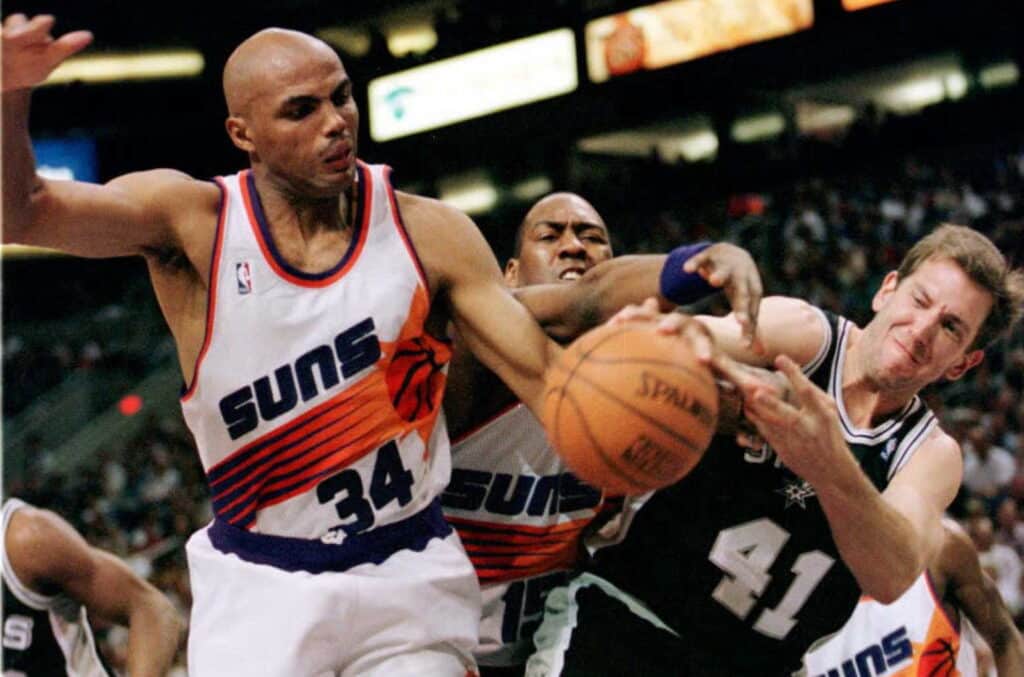
But after Barkley regressed some following the Finals loss, you had a No. 1 overall pick in David Robinson (The Admiral) who was an absolute menace for the Spurs. He just got a late start because of his military service, but once he got going, Robinson won Rookie of the Year in 1989-90, Defensive Player of the Year in 1991-92, and he was the MVP of the 1994-95 season, which was sandwiched between two years where he finished as the MVP runner-up. Just a dominant run with the highest PER in three straight seasons.
Then by the 1996-97 season, it was Karl Malone’s time in Utah with his first MVP award. His name was always in the mix for that, but he finally won it that year in a close vote (63-52) with Jordan, who he ended up losing to in the NBA Finals. The two met again as MVP finalists in the Finals in 1998, and Jordan of course won that one too for his sixth ring, keeping Malone and John Stockton ringless.
Malone was the MVP of the 1998-99 season too, but Utah lost in the second round to Portland. It’s hard to say if they would have defeated the Spurs, who had drafted Tim Duncan, the key to helping David Robinson to rings in San Antonio.
NHL
With Lemieux getting his two Stanley Cups in 1991-92, it was wide open for the best NHL player without a championship in the early 90s. Some could say Detroit’s Steve Yzerman, a center with some great numbers before he finally won a Cup in 1997 (then won two more).
I went with Brett Hull, a nepo baby who was peaking with a league-best 72, 86, and 70 goals in the 1990-92 seasons. He was on fire then, but he wouldn’t win a Cup until he went to the Dallas Stars for the 1998-99 season.
Then once you get to the 1994-95 season, you have to give it up to goalie Dominik Hasek. He won the Vezina (best goalie award) six times in 1994-01, which is absurd. He was also the Hart (MVP) winner in back-to-back years for Buffalo in 1997-98, so his metrics and accolades as a goalie far outweigh any skater without a ring in this era as the NHL was moving away from Gretzky vs. Lemieux lighting the lamp and moving towards teams like the Devils and Red Wings playing strong defense.
In fact, Hasek did not win a Stanley Cup until he left Buffalo for the Red Wings in the 2001-02 season, a dominant team with 116 points that year. He won the Cup for the first time at 37 years old.
MLB
Baseball had some great teams in the 1990s, including the Atlanta Braves and their brilliant pitching lineup despite the one championship win. But the Yankees became a dynasty with 4-of-5 titles in 1996-00, including a three-peat in 1998-00 that even saw Roger Clemens collect his first ring in 1999.
But while Derek Jeter and company made it hard to collect rings in that era, it was an awesome decade for great hitters, and we’re not just talking about the Mark McGwire vs. Sammy Sosa home-run chase.
Years before steroid use clouded his legacy, Barry Bonds was an elite player for the Pittsburgh Pirates where he won his first of a record seven MVP awards in the 1990 season. He left for the San Francisco Giants in 1993 where he collected his third MVP award. Some would argue he’s the best player to never win a World Series.
But there was a period between Bonds’ excellence in Pittsburgh and his steroid-impacted home run dominance with the Giants where a young Ken Griffey Jr. was as good as any player in baseball. He led the league in WAR in 1996-97 and was the AL MVP in 1997 with 56 home runs, a number he repeated in 1998. He also led the league in homers (48) in 1999.
Sadly, injuries prevented Griffey Jr. from reaching his full potential, especially after his 30th birthday. He was never the same player. His deepest playoff run was way back in 1995 when the Mariners lost 4-2 to the Indians in the ALCS.
1999-2010: The Greatest Expectations
Once you get into the late 1990s and early 2000s, ESPN and the internet become factors in building up the hype of young players before they’ve even played a game. High school players were going straight to the NBA in this era. The NFL draft became must-see TV.
It was also an era where three generational prospects were expected to be the next big thing, and somehow, Peyton Manning, LeBron James, and Sidney Crosby all lived up to and exceeded that hype.
Here are the best players without a championship at the time for the period of 1999-2010:
| Year | NFL Best | NBA Best | NHL Best | MLB Best |
|---|---|---|---|---|
| 1999 | Peyton Manning* | Karl Malone | Dominik Hasek* | Ken Griffey Jr. |
| 2000 | Peyton Manning* | Allen Iverson | Dominik Hasek* | Barry Bonds |
| 2001 | Peyton Manning* | Allen Iverson | Jarome Iginla | Barry Bonds |
| 2002 | Peyton Manning* | Kevin Garnett* | Jarome Iginla | Barry Bonds |
| 2003 | Peyton Manning* | Kevin Garnett* | Jarome Iginla | Barry Bonds |
| 2004 | Peyton Manning* | Kevin Garnett* | N/A (Lockout) | Barry Bonds |
| 2005 | Peyton Manning* | LeBron James* | Joe Thornton | Alex Rodriguez* |
| 2006 | Drew Brees* | LeBron James* | Sidney Crosby* | Alex Rodriguez* |
| 2007 | Drew Brees* | LeBron James* | Sidney Crosby* | Alex Rodriguez* |
| 2008 | Drew Brees* | LeBron James* | Alex Ovechkin* | Alex Rodriguez* |
| 2009 | Philip Rivers | LeBron James* | Alex Ovechkin* | Roy Halladay |
| 2010 | Philip Rivers | LeBron James* | Alex Ovechkin* | Roy Halladay |
NFL
When you get to that time in the NFL around 1999-2003, it was a huge transition period for the league, and especially at the quarterback position after Dan Marino, John Elway, Steve Young, Troy Aikman, and Warren Moon all retired.
Brett Favre already had his ring as the elder statesman. Kurt Warner was able to cash in on his storybook season right away with a Super Bowl win for the 1999 Rams. That quickly put Peyton Manning as the next in line after a record-breaking rookie season and a quick turnaround to 13 wins in 1999 where he was the MVP runner-up. There had never been a quarterback who threw for over 3,700 yards and 26 touchdowns in each of his first two seasons before Manning started to rewrite the record books.
He was destined to be the new Dan Marino, and that also included some of Marino’s playoff struggles after Manning started 0-3 in the playoffs with the Colts. After a 2004 loss to the Patriots (20-3) in a season where Manning threw 49 touchdowns to win his second MVP and break Marino’s record for touchdowns, Boomer Esiason noted that Manning was his generation’s Marino, which didn’t sit well with the man himself:
But at a time when Tom Brady won three Super Bowls in four years for the Patriots as Manning’s main rival, the playoff failures were held against him despite Manning’s statistics being overwhelmingly better than any other quarterback at the time. The criticism only got louder after another one-and-done postseason in 2005 after a wild loss to the Steelers.
However, the Pittsburgh loss taught Manning to work on his footwork, throwing better under pressure, and throwing better off platform. He played as well as he ever did in the 2006 season, and the Colts finally slayed the New England dragon and won Super Bowl 41, giving Manning a championship in Year 9. It wasn’t the longest wait ever for a quarterback, but it was one of the longest for someone to get to their first Super Bowl.
That put the pressure on Drew Brees in New Orleans to follow a Super Bowl run of Brady (2003-04), Ben Roethlisberger (2005 Steelers), and Manning (2006). It didn’t take very long as Brees also was a Year 9 Super Bowl winner, beating Manning’s Colts in Super Bowl 44 in the 2009 season.
Then even before you could think of putting Aaron Rodgers in this space, he won the Super Bowl in 2010, his third year as a starter with Green Bay. That’s what makes this specific era so unique in NFL history in that so many top quarterbacks, including Eli Manning’s upset wins in 2007 and 2011, were able to collect rings in such a short period of time. That’s never happened like that in any other era.
That’s why in 2009, you have to look at Philip Rivers in San Diego as the best quarterback without a ring as he was really peaking early in 2006-09 with that team. Everyone else from Warner to Brady to Big Ben to Peyton to Eli to Brees to Rodgers had a ring already.
NBA
In the post-Michael Jordan in Chicago era, the NBA was looking for that next crop of superstars with Barkley, Olajuwon, and Malone also aging out. This is when players like Kevin Garnett, Vince Carter, Tracy McGrady, and Allen Iverson started to shine in the slowest-paced era of defensive basketball with little ball movement, heavy isolation play, mid-range shots galore, a lack of 3-point shots, and just static offense really.
That’s how I ended up with Allen Iverson and Kevin Garnett for a couple of years each as the top dog without a ring for players who had MVP seasons. Iverson never won one while Garnett later won one with the Celtics in 2008 after he left Minnesota.

But the next big thing in basketball was well on the way in LeBron James. Where someone like Peyton Manning was expected to be great because of his father Arch’s NFL career and a very successful college career at Tennessee that led to the No. 1 pick, LeBron was getting hyped in high school in Ohio. He was on the cover of magazines without ever declaring a college career as you could skip it and go right to the NBA back then.
James was the No. 1 pick of the famed 2003 draft that included future teammates Dwyane Wade and Chris Bosh as well as Carmelo Anthony. But LeBron was staying in Ohio with the Cleveland Cavaliers, and all the weight of the world was on him to succeed in a league that saw Michael win six and Kobe Bryant was chasing his own handful in Los Angeles.
LeBron won Rookie of the Year and didn’t take long to live up to the hype. By his third season in 2005-06, he was first-team All-NBA, averaged 31.4/7.0/6.6, an MVP runner-up, and he started having his own battles with the Detroit Pistons in the playoffs similar to a young Jordan in the 80s.
The 2007 playoffs had the moment where he scored 25 straight against Detroit to help lead his team to the NBA Finals, but he was swept by a superior San Antonio team. That just kept adding more pressure on LeBron to win a championship as Kobe won two more as the lead player without Shaq in LA.
But it wouldn’t be until a move to the Miami Heat where LeBron would remove the title of the best player without a championship. It took nine seasons, the same number as Manning in the NFL.
NHL
After Dominik Hasek won the Cup in 2002, that really reset things to looking for a young talent on the rise as the best player without a ring. There were a few choices out there, but I ended up picking Calgary’s Jarome Iginla. In 2002-04, he led the league in goals twice and was a Hart runner-up twice.
Iginla had a great playoff run in 2004 to lead Calgary to the Stanley Cup Finals where they lost to Tampa Bay, a fitting ending before the whole NHL was locked out and no 2004-05 season was played.
When the NHL resumed play with the 2005-06 season, Joe Thornton shined with a 125-point MVP season even after moving from Boston to San Jose. He never won a Stanley Cup in 24 seasons.
But when the NHL returned after the lockout, it was the start of a new era with Alex Ovechkin (2004) and Sidney Crosby (2005) as the No. 1 overall picks in the last two drafts. They made their debuts in the 2005-06 season as did Evgeni Malkin in Pittsburgh a year later. This would lead to a heated rivalry – not that type, though you could say maybe it inspired the show with a Russian and a Canadian – in the Eastern Conference for years to come between the Penguins and Capitals with Crosby and Ovechkin battling for superiority.
But in the 2008-09 season, Crosby’s Pens battled back from a 2-0 deficit and won Game 7 in Washington to advance before eventually winning a Stanley Cup against Detroit, the team that beat them in the Cup the year before. Crosby had his captain moment in Year 4, leaving the title of the best to never do it in Ovechkin’s hands for a long time.
But not forever.
MLB
At the turn of the century in baseball, you had some new teams step up to win in the wake of the Yankees’ dynasty run, including the 2001 Arizona Diamondbacks (first rings for ace pitchers Curt Schilling and Randy Johnson), 2003 Marlins (a young Miguel Cabrera), and 2004 Red Sox ended the curse with David Ortiz and company. You also had Albert Pujols win his first World Series with the St. Louis Cardinals in 2006, ensuring another elite hitter wouldn’t go ringless like Bonds did.
As much as baseball enjoyed the home run highlights like when Barry Bonds had 73 dingers in 2001, it was trying to get away from the steroid scandals and get back to a “clean” game. Hitters like Pujols and Alex Rodriguez were important in building up the next era, and ARod was a great choice for the next villain after he won MVP in Texas and immediately joined the Yankees in 2004 in hunt of that elusive World Series.
Rodriguez won two more MVP awards before he finally got that championship win in the 2009 season, the last World Series win for New York. That meant finding a new player for the title of best to never do it, and there were certainly some names you could float out there for that late 2000s/early 2010s era, including Justin Verlander, Evan Longoria, Ryan Bruan, etc.
We settled on Roy Halladay, a 2-time Cy Young winner who had some of his best years for the Phillies in 2010-11. But you could have picked from many names in this little period as baseball was seeking its next young star.
2011-2016: The Great Search for Tomorrow’s Legends
Moving into the 2010s, there was a yearning for new superstar talent to lead the way as players like Manning, Kobe, and Alex Rodriguez were getting older and more injured. Fortunately, new stars did emerge like Steph Curry to lead the 3-point renaissance in the NBA, NFL quarterbacks started to get more mobile, and mega talents like Mike Trout (MLB) and Connor McDavid (NHL) were drafted.
Here are the best players without a championship at the time for the period of 2011-2016:
| Year | NFL Best | NBA Best | NHL Best | MLB Best |
|---|---|---|---|---|
| 2011 | Philip Rivers | Kevin Durant* | Alex Ovechkin* | Justin Verlander* |
| 2012 | Philip Rivers | Kevin Durant* | Alex Ovechkin* | Mike Trout |
| 2013 | Philip Rivers | Kevin Durant* | Alex Ovechkin* | Mike Trout |
| 2014 | Andrew Luck | Kevin Durant* | Alex Ovechkin* | Mike Trout |
| 2015 | Cam Newton | Kevin Durant* | Alex Ovechkin* | Mike Trout |
| 2016 | Matt Ryan | James Harden | Alex Ovechkin* | Mike Trout |
NFL
With every elite quarterback having a ring at this point, it was still on Philip Rivers to join the club. The problem is the Chargers missed the playoffs in 2010-12 and Rivers was throwing some really bad picks to lose games. He lost his shine and was losing ground in any top quarterback discussion with the league drafting players like Cam Newton, Colin Kaepernick, Andrew Luck, and Russell Wilson in 2011-12.
Then with Wilson winning the Super Bowl in his second year in 2013, that really put more pressure on Luck to respond as the most hyped quarterback prospect since Peyton, and what a coincidence he was playing for the same team, the Colts. That’s why I think you could say Luck surpassed Rivers in 2013-14 with the way he won that 28-point comeback against the Chiefs in the playoffs, then had another huge season in 2014, leading the team to the AFC Championship Game. But like many, the Patriots were an obstacle for him and he was injured in 2015.
The 2015 season was really a sign of where the league was at the moment at the quarterback position with Manning on his last legs in Denver, Eli struggling in New York, Rodgers fell off that year without Jordy Nelson, and Rivers was still struggling. You had a season where Carson Palmer was consistently elite, Wilson was hot to end it, and Cam Newton went crazy over the second half in an MVP season that ended with a Super Bowl loss for Carolina.
By 2016, it was Matt Ryan’s turn in Atlanta, running Year 2 of a Kyle Shanahan offense to perfection in what was a consistent, highly-efficient MVP season that should have ended with a ring if not for a long line of mistakes the team made in Super Bowl 51 to let 28-3 happen.
Alas, the NFL needed new blood at the position starting in 2017, and some big drafts in 2017-18 would deliver it.
NBA
With LeBron James having his championship moment to end the 2011-12 season with Miami, the pressure fell on Kevin Durant to win one. He was a great scorer and could have actually beat James to a first ring with a young Oklahoma City Thunder team that also had Russell Westbrook and James Harden, but they weren’t good enough yet to beat the Heat in the 2012 Finals.

After Harden left the team to do his own thing as an MVP winner, the Thunder tried to get back to the Finals to no avail after some tough playoff losses and injuries. After James led Cleveland to a shocking 3-1 comeback against the 73-win Warriors in the 2016 NBA Finals, Durant ended up joining the Warriors for the 2016-17 season, which is how he ended up winning his two rings with a repeat there.
That’s why in 2016, you had to look at James Harden as the best to never do it. He was on the verge of his first MVP after finishing second place twice, and he was about to win three straight scoring titles for Houston.
NHL
In the NHL following Crosby’s first Stanley Cup win, we were seeing teams like the Blackhawks (Patrick Kane and Jonathan Toews) and Kings (Jonathan Quick and Anze Kopitar) win championships. Plural. There was also a repeat for Crosby and the Penguins in 2016-17, which again came at the expense both times at Alex Ovechkin’s Capitals.

In the 2010s, Ovechkin continued to be an elite goal scorer, he won the Hart again in 2012-13, and Washington had some great seasons where it won or flirted with the Presidents Cup (best record). But the playoff disappointment kept coming until finally in 2018, the 13th season for Ovechkin, they were able to get past Pittsburgh and get over the hump by winning the Stanley Cup against the Vegas Golden Knights, an expansion team at the time.
Ovechkin finally had his Stanley Cup after one of the longest waits for one of the all-time greats.
MLB
Like we said in the previous section, MLB was searching for its next superstar. Detroit pitcher Justin Verlander was certainly as good as anyone in that 2011 season when he won the MVP and Cy Young for the Tigers. He eventually won two World Series for Houston in 2017 and 2022.
But baseball had its new star when the Angels landed Mike Trout, who was the 2012 Rookie of the Year and a runner-up for AL MVP. Over the next decade, Trout was a statistical juggernaut and a 3-time MVP, only ratcheting up the absurdity that he’s been to the playoffs one time in 2014 as the Angels simply couldn’t win despite his greatness.
From the period of 2012-16, Trout was worth 47.1 WAR, almost 15 more wins than the next-closest player (Robinson Cano). That’s only the tip of the iceberg for Trout, who would soon find a teammate worthy of his numbers.
2017-2025: The Denial of Greatness
In the last decade, we’ve seen the rise of a Kansas City dynasty with Patrick Mahomes in the NFL, some repeats in the NHL that didn’t involve Connor McDavid, a lot of new stars winning early rings in the NBA, and “Moneyball” in the MLB right now means how much can you afford to pay to buy a championship.
Here are the best players without a championship at the time for the period of 2017-2025:
| Year | NFL Best | NBA Best | NHL Best | MLB Best |
|---|---|---|---|---|
| 2017 | Matt Ryan | James Harden | Connor McDavid | Mike Trout |
| 2018 | Patrick Mahomes* | Giannis Antetokounmpo* | Connor McDavid | Mike Trout |
| 2019 | Lamar Jackson | Giannis Antetokounmpo* | Connor McDavid | Mike Trout |
| 2020 | Lamar Jackson | Nikola Jokic* | Connor McDavid | Mike Trout |
| 2021 | Josh Allen | Nikola Jokic* | Connor McDavid | Shohei Ohtani* |
| 2022 | Josh Allen | Luka Doncic | Connor McDavid | Shohei Ohtani* |
| 2023 | Lamar Jackson | Luka Doncic | Connor McDavid | Shohei Ohtani* |
| 2024 | Lamar Jackson | Luka Doncic | Connor McDavid | Aaron Judge |
| 2025 | Josh Allen | Luka Doncic | Connor McDavid | Aaron Judge |
NFL
For years, Peyton Manning vs. Tom Brady dominated the AFC and the NFL. Manning was a worthy rival to Brady’s dynasty in New England, but once he retired after 2015, it’s no surprise that’s the only time where Brady went to three straight Super Bowls, winning two of them.
Brady needed a new rival, and when the likes of Matt Ryan, Philip Rivers, Ben Roethlisberger, or an injured Andrew Luck (never played in 2017) weren’t cutting it, that’s when Patrick Mahomes stepped in. After sitting on the bench as a rookie, he immediately looked like the best player in football by throwing 50 touchdown passes in 2018, and about the only thing stopping him from knocking off Brady in the AFC Championship Game that year was the clock and archaic overtime rules.
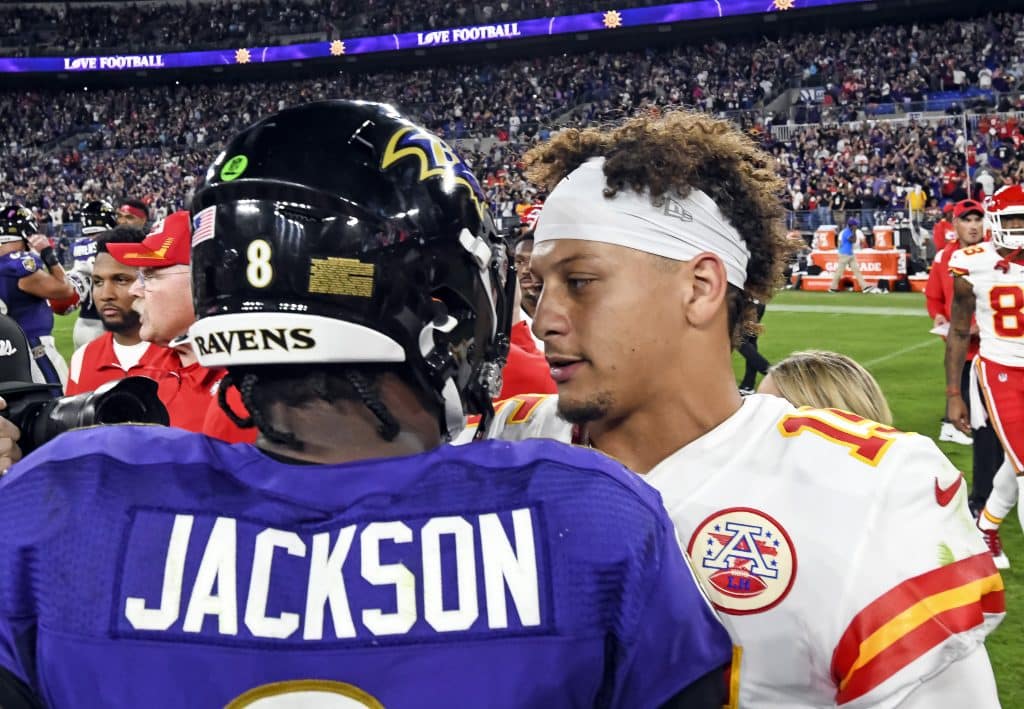
By 2019, Mahomes was already able to win a Super Bowl, setting the Chiefs on a path towards a dynasty that would win two more rings and appear in 5-of-6 Super Bowls in 2019-24, coming closer than any team ever had to a Super Bowl three-peat.
But Mahomes’ historic success has come at the expense of the other great quarterbacks of his era, namely Lamar Jackson and Josh Allen, who were drafted a year after him in 2018. You can say those two have basically been battling it out since 2020 when Allen had his breakout year for the title of the best non-Mahomes quarterback in the NFL.
Jackson had the early success with an MVP in 2019, then was named MVP again in 2023 and first-team All-Pro in 2024 after one of the most controversial MVP votes ever. Allen took longer to develop, but he had his breakout year in 2020 and has been an annual MVP contender ever since, and he’s played better in the postseason than Jackson has.
But while Jackson has always struggled with Kansas City, Allen has mastered beating them in the regular season (5-0 since 2021) while still holding an 0-4 record against them in the playoffs despite some strong stats in those games.
The one that always stings the most is the 2021 AFC divisional when Allen thought he had the game won with 13 seconds left after another go-ahead touchdown, but the Chiefs were able to force overtime with a field goal, and they got the ball in overtime and marched for a touchdown, which finally put an end to that system of overtime in the playoffs.
Allen’s only come up shorter and shorter in the playoffs against the Chiefs in the two games since that one that probably should have been the moment for him and coach Sean McDermott, who are no longer together after Year 8 following Buffalo’s ugly playoff loss in Denver where Allen turned it over four times.
That’s a funny one because it’s probably the playoff loss that McDermott is least culpable for, but it’s the one that gets him fired because the Bills knew they had no Kansas City in their path of Super Bowl 60, and they still found a way to blow it in Denver in the divisional round.
You can really interchange Allen and Jackson for this title as I’ve done in the table above, but right now, it’s Allen after 2025 after Jackson was injured again and missed the playoffs.
But it really is Kansas City’s historic success and their wins against these teams that have kept them from advancing further with better seeds and playoff wins. Will that continue if the Chiefs can’t get back on top of the AFC? We’ll find out, but it’s statistically likely for both Allen and Jackson that they would get to a Super Bowl and even win one someday given their MVP-caliber statistics and high winning percentages at the most important position.
However, both have squandered golden opportunities to get this done, and those windows don’t stay open forever, so they’ll both head into 2026, Year 9, with a new head coach. In Allen’s case, he has offensive coordinator Joe Brady getting promoted, so how much really changes there?
But we really have gotten to a point where either Allen or Jackson winning a Super Bowl would break some precedents. Peyton Manning was the only quarterback to need seven postseasons to appear in his first Super Bowl. Every other quarterback who won got there in their first five postseasons.
Allen has already lost seven times in the playoffs without getting to a single Super Bowl, so he’ll need eight or more postseasons just to get there once. Jackson is 3-5 in the playoffs, so we’ll see if he needs six or more playoff years to get it done.
NBA
Even with all the playoff injuries in the last decade, this has actually been a great era for NBA stars winning titles unless you’re a fan of James Harden, Luka Doncic, or Joel Embiid. They’re still waiting, and the injuries for Embiid are usually so problematic that he’s yet to get past the semifinals in Philly.
But Giannis Antetokounmpo won back-to-back MVPs before he cashed in with 50 points in Game 6 of the 2021 NBA Finals to defeat Phoenix and have his Finals MVP moment with a ring.
Nikola Jokic is having an all-time great run as he looks to lead the NBA in PER for the sixth-straight season. But in 2023, he was able to turn his first two MVP awards into a season with a ring after taking down Jimmy Butler and the Heat.
A year later, Jayson Tatum and the Celtics made up for that 2022 loss to Golden State by beating Doncic and the Mavericks to win a ring with a dominant team. Good thing he got that in before his Achilles injury a year later in the playoffs.
Last year, Shai Gilgeous-Alexander showed one MVP and another No. 1 seed were enough to get him a ring for the Thunder, and he’s the favorite to repeat this season.

That’s why it’s really been on Luka Doncic since the 2022-23 season as the best player without a ring. He’s a triple-double machine with sick career averages (29.0/8.5/8.3), his playoff numbers are great, and he’s already won a Rookie of the Year award and is a 5-time first-team All-NBA selection, something he achieved before the age of 25.
But after the shocking trade from Dallas to the Lakers, Doncic hasn’t had the desired impact yet on his new team, and the Lakers don’t look to be in serious title contention even if they are the current No. 6 seed with an outside shot of moving up to No. 3 by season’s end.
So, even if Doncic is declining, the fact is SGA, Giannis, and Jokic all have rings already. The legends (LeBron, Curry, Durant) have had their rings a long time now. At that point, you might as well be looking towards Victor Wembanyama or even rookie Cooper Flagg as the next great players to replace Doncic as the best to never do it. But they still have to show more before we can talk like that about them. Remember, Doncic has at least been to the NBA Finals and a second Western Conference Finals in his career.
NHL
It’s really been a clean sweep for Connor McDavid as the best NHL player without a ring going back to the 2016-17 season when he won his first Hart with his first 100-point season. The crazy (or maybe just logical) thing is the No. 2 player without a ring is probably his teammate Leon Draisaitl, who has been in Edmonton since the 2014-15 season as they share this drought together.
But McDavid has absolutely lived up to the hype as the next Crosby as the No. 1 pick of the 2015 draft in every way but the Stanley Cup wins. He’s been there the last two years in the Finals against Florida, but the Panthers got the best of him both series.
Meanwhile, McDavid has watched players like Nikita Kucherov (Lightning) and Nathan MacKinnon (Avalanche) hoist the cup already. In fact, the current top five in points this NHL season are McDavid, MacKinnon, Kucherov, a young Macklin Celebrini in San Jose, and Draisaitl, so this is his main competition.
The precedent was recently set with Ovechkin waiting until Year 13 to finally win the Stanley Cup for Washington. But with the Oilers currently sitting at 28-22-8 in Year 11 for McDavid, they are +1100 to win the Cup at FanDuel, the fifth-best odds.
This might take a dozen years, if it’s going to happen at all for him.
MLB
Despite its lack of a salary cap, you know baseball was doing a great job of getting new champions (23 years without a repeat in 2001-23) when even the Kansas City Royals (2015) and Chicago Cubs (2016) were able to win a World Series.
But since 2017, there has been more of a money-powered push to the World Series with the Dodgers (3-2) and Astros (2-2) accounting for 50% (9-of-18) of the World Series appearances. That’s not great.
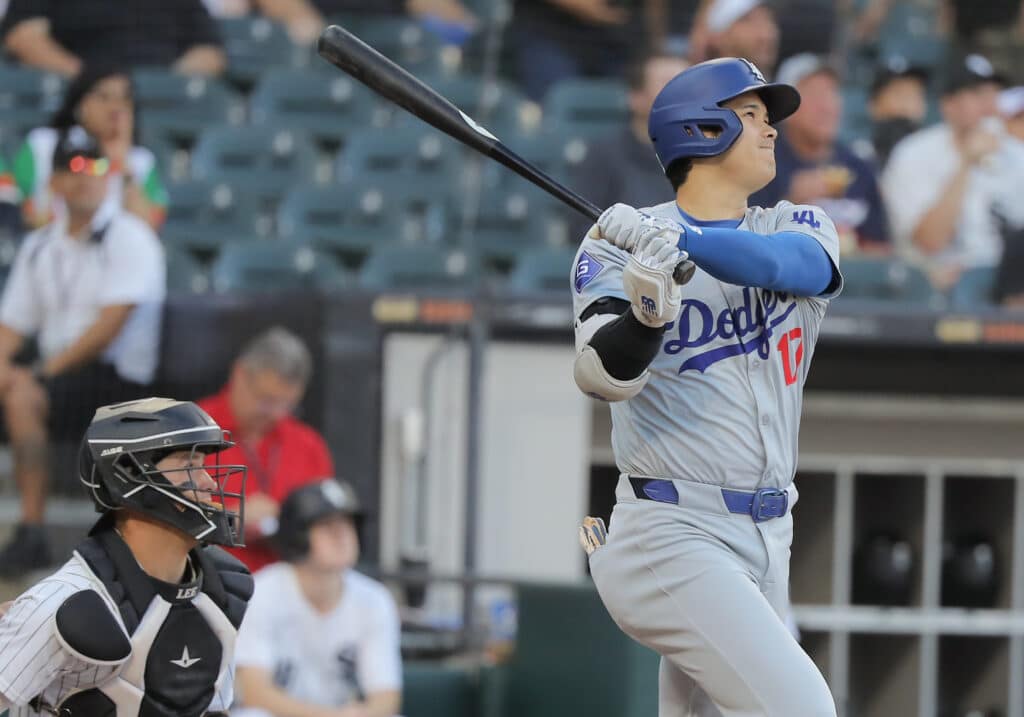
Mike Trout’s statistical dominance has quieted down too since his last MVP season in 2019, a year after the Angels acquired Japanese sensation Shohei Ohtani, the 2018 Rookie of the Year. By 2021, Ohtani was the MVP of the league, a historic dual-threat player with his ability to hit home runs at scale and pitch well.
You’d think the Angels would be back in the playoff mix with Trout and Ohtani, but that was never the case. That’s why arguably the best MLB tweet ever made in 2021 is this one that talks about how great Ohtani and Trout were in an Angels loss, a common occurrence in real life:
But for the 2024 season, Ohtani was wise to take a $700M contract from the Dodgers where he’s won back-to-back World Series even if his playoff performances haven’t always been up to snuff. But on a team that was already loaded, Ohtani is a two-time champion, and the Dodgers are favorites to three-peat in 2026.
Once Ohtani had his ring, that left Aaron Judge of the Yankees as the logical choice as the best player without a championship. Also a Rookie of the Year, Judge has won 3-of-4 MVP awards in the AL since 2022, and he’s hit over 50 home runs in four different seasons (tied for the most ever). He’s one of the most prolific home-run hitters in MLB history by rate, reaching 250, 300, and 350 home runs in fewer games than any player ever.
But while Judge has had some memorable moments with 17 home runs in eight postseasons with the Yankees, he also had some memorable gaffes in the 2024 World Series loss to the Dodgers, and his teams just haven’t been able to get over the hump in the playoffs.
Conclusion: Is Allen/McDavid/Judge/Doncic the Best Group to Never Do It?
So, what did we learn? Great players usually win championships. Even out of the 201 selections I made here, 91 of those still eventually won a championship (45.3%). That number can still obviously improve if one of these players wins one, which the odds favor happening eventually.
But it clearly is not unprecedented for a group like this to be ringless at the same time. First, we need an acronym for this group. Judge/Allen/McDavid/Doncic = JAMD as in they’re jammed from winning any rings as of today.
Is JAMD the best/most talented group on this list? No, I think that clearly has to be 1986-89 when it was Dan Marino, Michael Jordan, Mario Lemieux, and Roger Clemens. Not surprised 75% of them won multiple championships later too.
I think I’d also rank the Peyton Manning years higher when you can have someone like Kevin Garnett/LeBron James to go with one of Bonds/ARod/Griffey and Hasek/Thornton/Iginla. Ditto for Brees/LeBron/Sid/ARod.
But maybe one of the most important things to note in my lists is that 2017, 2024-25 are the only three years where no one ever won a ring. The last two years are obvious as there just hasn’t been enough time to change that yet. But 2017? That’s a little different, and it’s still possible to end it if one of Harden, McDavid, or Trout (fat chance) win a ring.
That leaves one last question. What if JAMD never win a single championship between them? Even if we replace Allen with Lamar, it’s the same level of shock. Would that be the greatest group at one time to never win a championship?
Now that might get me to say yes, because then the main competition is one of those years in the 90s with Marino and Bonds/Griffey. Then you can sub in your NBA choice (Barkley or Malone) and your NHL choice could be Pavel Bure for all I care as they’d have an argument.
But we’re still a good number of years away from saying JAMD never won a championship. If it does happen, blame Mahomes/Chiefs, Judge’s late start/running into the Dodger$ in his prime, and maybe Dallas should have tried keeping Jalen Brunson and Kristaps Porzingis as Luka’s Big 3.
Frankly, the player who probably deserves the most heat here is McDavid. But because the NHL has the lowest visibility of these sports in the mainstream, he gets the least amount of attention for his shortcomings. When people say “McDavid is the Allen of the NHL” they really have it backwards. McDavid is more accomplished and better statistically at his sport than Allen is at his. Allen is the lucky one to get that comparison.
But such is life. If you want a championship, go earn it. Or just get paid to win one like Ohtani did for the Dodgers as Mike Trout would have never sold out like that. He’s got more pride and 1921 Akron Groomsmen records to break.
Related Articles:
- Ranking the 36 Super Bowl-Winning Quarterbacks into Tiers: Where Does Sam Darnold Fit?
- Predicting the NFL Starting Quarterbacks for the 2026 Season
- After a Close NFL 2025 MVP Vote, What Do People Even Value in a Quarterback These Days?
- Lessons from the 2025 NFL Season, 2026 Storylines, and the Early Super Bowl 61 Odds
- Sam Darnold, the Patriots, and the Curse of MetLife Stadium (A Super Bowl 60 Story)
- The Worst Super Bowl Teams in NFL History: Are the 2025 Patriots in the Mix?
- 2025 Final NFL Quarterback Rankings: Matthew Stafford Is the MVP
- Patrick Mahomes Turns 30: The Best There Is, the Best There Was, the Best There Ever Will Be?
- 2025 NFL Award Nominees and Best Bets: Can We Get a Good and Logical MVP Race?
- 2025 NHL Stanley Cup Finals Preview: Connor McDavid’s Greatness vs. Florida Panthers’ Repeat