Ranking the 36 Super Bowl-Winning Quarterbacks into Tiers: Where Does Sam Darnold Fit?

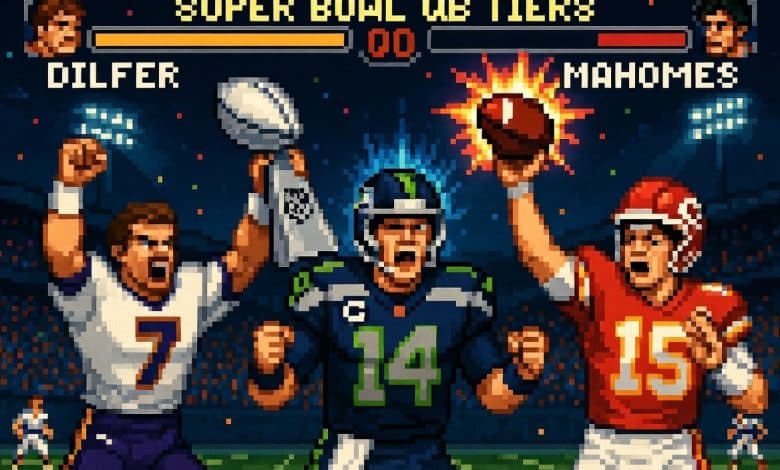
If the last two NFL seasons have proved anything, it’s that winning a Super Bowl doesn’t automatically make you an elite quarterback such as in the cases of Jalen Hurts (2024 Eagles) and Sam Darnold (2025 Seahawks). If anything, they just proved you don’t need an elite quarterback as long as the rest of the team, namely the defense, can get the job done.
Still, winning a Super Bowl as a starting quarterback does put you in a small group of players. Since 1966, over 650 quarterbacks have started a game in the NFL, yet Sam Darnold became just the 36th different starter to win one of the first 60 Super Bowls in NFL history. That’s about 5.5% of all starters at the most important position.
Alas, Darnold’s unique story and path to a championship have some still questioning his abilities. Darnold is the only quarterback to win a Super Bowl with his fifth team (Jets, Panthers, 49ers, Vikings, and Seahawks). After Darnold led all quarterbacks in turnovers in the 2025 regular season, he led a Seattle offense that became the only Super Bowl winner out of 60 teams to not have a single giveaway in the postseason.
But since Darnold didn’t have a Super Bowl MVP type of performance against the Patriots, that was enough for an account with 160,000 followers to ask if he’s the worst quarterback to ever win a Super Bowl.
Darnold is clearly not the worst quarterback to win a Super Bowl. Some of us remember Trent Dilfer, right? His name only kept coming up in the weeks leading up to Super Bowl 60 because young Drake Maye was winning playoff games despite performing at a 2000 Dilfer-like level. That discourse would have been awful if he did it a fourth time in a win.
But where does Darnold rank among the 36 Super Bowl winners given his unique career path? He didn’t have a true breakout season until Year 7 with the Vikings in 2024, then he backed it up with another 14-win season in Seattle, putting him in elite company where he still stands out like a sore thumb:
Maybe 2024 was the start of a great run that leads Darnold to Canton. I’d say crazier things have happened, but a HOF run for a quarterback after being this unaccomplished and statistically poor in his first six seasons would be unprecedented. The closest any quarterback in the Super Bowl era came to a HOF run after such a slow six-year start was Steve Young, and even that isn’t fair since he spent Years 3-6 as Joe Montana’s backup in San Francisco, a role he performed well.
But I figured it would be a good February thought exercise to rank the 36 Super Bowl-winning quarterbacks into tiers to see where Darnold currently ranks and some thoughts on where he could finish his career. This is a different goal than just ranking the quarterbacks 1-through-36, something we could do in the coming weeks from a different angle. This is about a tier approach and matching players accordingly.
Then I thought about what the tiers should represent. I considered doing a “Dynasty Tier” at the top that would have everyone who won at least three rings for a dynasty (Bart Starr, Terry Bradshaw, Joe Montana, Troy Aikman, Tom Brady, Patrick Mahomes). But then that’d inevitably turn into a ring-counting list, which you could just look up on Wikipedia. That’s not useful.
“Rankings don’t matter at all” is a line that was uttered seconds ago in the anime I’m watching on Netflix for background noise (Love Through a Prism) as I write this paragraph. I don’t necessarily agree with that, but I am not concerned with rankings inside each tier as much as I am getting the right guys into the right tiers. I’m not listing the quarterbacks in alphabetical order, so you could argue amongst yourselves if you think this is my true 36-1 list or not. Some hints will be dropped.
So, let’s break the 36 Super Bowl winners into seven tiers and see how things look.
Table of Contents
Ranking the 36 Super Bowl-Winning Quarterbacks into Seven Tiers

I ended up grouping the 36 starting quarterbacks to win a Super Bowl into seven tiers of unequal sizes. Actually, I started with six tiers before breaking up my 10-player tier that just felt off into a seventh tier.
Beyond my usual way of how I rank quarterbacks (mixture of stats, value/impact, eye test, longevity, durability, etc.), I also strongly considered the quarterback’s career arc and story to fit them into a tier.
Let’s look at each tier from the weakest to the strongest. Note that the write-ups will get shorter the further we go on as it’s easier to explain the greatness of Drew Brees or Steve Young in a few sentences than it is to explain the weird career arcs of Nick Foles and Brad Johnson.
Tier 7: The One-Shot Wonders (“Everything In Its Right Place”)
In our lowest tier, these four quarterbacks really exemplify the idea of “right place at the right time” as they never came close to repeating their Super Bowl win. None of these quarterbacks will ever be in the HOF, none reached multiple Pro Bowls, and they combined for one playoff win the rest of their careers after winning their only Super Bowl.
Unlike the Radiohead song that describes them, these are your one-shot wonders who caught lightning in a bottle.
Trent Dilfer
Look, someone has to be the “worst quarterback to ever win a Super Bowl” and that player is still Trent Dilfer. The funny thing is he left one blossoming elite defense (Buccaneers) that would win a Super Bowl in 2002 to join another defense ready for all-time discussions with the Baltimore Ravens in 2000.
But Tony Banks was the starter to begin the season with Dilfer his backup. The 2000 Ravens infamously went the entire month of October (five games) without scoring a single touchdown. That’s when the move was made from Banks to Dilfer, who still failed to score a touchdown in his first start of the season too.
But Dilfer actually had five games in a row with multiple touchdown passes before settling in as the ultimate game manager for defense and special teams units that would outscore multiple teams in the playoffs by themselves, including the huge road win against No. 1 seed Tennessee and Super Bowl 35 against the Giants.
Baltimore was so aware that Dilfer was a mere caretaker during this run that they decided to not re-sign him, making him to this day the only quarterback to be let go after winning a Super Bowl (excluding retired players). He signed as a backup in Seattle in August 2001 and played seven more NFL seasons, going 18-21 as a starter and never coming close to another playoff start or win.
To this day, Dilfer is the go-to name for someone devaluing rings in a debate because he’s been universally accepted as the worst quarterback to win a Super Bowl.
Doug Williams
Doug Williams was a first-round pick (17th overall) by Tampa Bay in 1978 at a time when black quarterbacks were not respected around the NFL. That’s reflected in him only getting to join a desperate expansion team that lost its first 26 games in 1976-77.
But as fate would have it, a young offensive coordinator named Joe Gibbs joined the Bucs in Williams’ rookie year. That connection would prove invaluable as Gibbs later recruited Williams to join him in Washington where he was a HOF coach who won three Super Bowls with three different quarterbacks, none of which will be in the HOF.
Williams’ path to that second ring for Gibbs in 1987 was most unusual. He sat out the 1983 season after Tampa Bay refused to pay him a $600,000 contract, offering $400,000 instead for a player who was already making less money than 12 backup quarterbacks. Williams played in the USFL instead in 1984-85 before joining Gibbs in Washington in 1986.
In that second season together in 1987, Williams came off the bench multiple times to win games after starter Jay Schroeder struggled. For the playoffs, Williams was chosen as the starter and guided the team on an improbable run, upsetting the Bears on the road, surviving the Vikings in a 17-10 final, and then Williams’ career day in the Super Bowl against Denver. He threw for four touchdowns in the second quarter alone on the way to winning MVP in a 42-10 rout. It’s the greatest quarter in Super Bowl history for a player.
Pretty incredible too since Williams had a passing success rate of 24.7% in four playoff starts with Tampa Bay, a truly abysmal number. Even in that Washington run his rate was only 40.7%, but one thing Williams was always elite at was avoiding sacks. His 3.24% sack rate is the third lowest since 1950, right up there with Peyton Manning and Dan Marino at 3.13% each.
But after his Super Bowl win, Williams played just two more seasons and was 5-7 as a starter for Washington. Definitely a great twist of fate that Gibbs thought of him in 1986.
Jeff Hostetler
The New York Giants used a third-round pick on Jeff Hostetler in the 1984 draft. Few draft picks on a backup quarterback have ever proved more valuable than this one. Hostetler backed up Phil Simms for years on Bill Parcells’ team, only making two starts prior to that 1990 season.
But after Simms was injured in a loss against Buffalo in December, Hostetler had to take over for the reason of the season. He got a good look at that Buffalo defense, and after winning his first four starts, including an upset in San Francisco in the NFC Championship Game after Roger Craig fumbled, Hostetler got to face those Bills in a classic Super Bowl.
Hostetler was incredible on third downs, the Giants had the ball for over 40 minutes, and they won the game 20-19 after Buffalo kicker Scott Norwood had the biggest missed field goal in NFL history.
Hostetler won the starting job from Simms in 1991, but he broke his back after a weird season that saw him throw 5 touchdown passes during a 7-5 start. He split time with Simms in 1992 before joining the Raiders in 1993 where he won one wild card game against Denver before losing 29-23 to those Bills in his final playoff game.
Hostetler finished his career with a 4-1 playoff record, throwing 7 touchdowns to no interceptions for a 112.0 passer rating on 115 attempts. He did need an all-time fumble and all-time missed kick to get his ring, but he earned it too the hard way as a backup on the right team at the right moment.
Jim McMahon
Our only Tier 6 quarterback to win the Super Bowl as a first-round pick for the team that drafted him, Jim McMahon had a strange career arc. He relied on Walter Payton running the ball and a great defense led by Mike Singletary for much of his success, but there’s also no denying he was better than the other quarterbacks the Bears tried winning games with in the 1980s like Steve Fuller, a young Doug Flutie, and Mike Tomczack.
At one point in 1984-87, McMahon won 25 consecutive starts, including the Super Bowl for that vaunted ’85 Bears team. That’s an all-time NFL record that usually doesn’t get recognized because it wasn’t 25 games in a row. He missed time with injuries, which would plague him the rest of his career.
After winning the Super Bowl behind one of the greatest defenses ever, McMahon was 0-3 as a playoff starter the rest of his career. By the time he was 30 in 1989, he was out of Chicago and on a journeyman path, playing with six more franchises to end his career, including a Super Bowl win as Brett Favre’s backup for the 1996 Packers.
McMahon was decent for a game manager type bolstered by an epic defense, but his inability to stay healthy and the Bears’ struggles to have playoff success outside of the 1985 season is why that team’s known for that one season instead of the whole decade.
Tier 6: The Redeemed Journeymen (“We Could Be Heroes Just for One Day”)
In Tier 6, we have seven quarterbacks who went on quite the journey to redemption to win their lone Super Bowl as well as one exception who did it twice. As of 2026, none of these quarterbacks are in the HOF because they all come with success that had caveats and yeah-buts attached to it.
Jim Plunkett
I said every quarterback in this tier has one ring but one, and we’re starting it with the two-ring winning Jim Plunkett, who got it done for the Raiders in 1980 and 1983. But that postseason success took almost a decade after the Patriots made Stanford’s Plunkett the No. 1 pick in the 1971 draft.
Plunkett threw 19 touchdown passes as a rookie, impressive for 1971 standards, but that was really the highlight of his five seasons there. He was traded to the 49ers in 1976 where he continued to not have a winning record as a starter for the first nine years of his career.
But joining the Raiders as a reserve in 1978 was a great move as an injury to Dan Pastorini in 1980 put Plunkett in the spotlight for coach Tom Flores. He went 9-2 as a starter on a good team, then caught the break of breaks in the 1980 AFC divisional round at Cleveland after league MVP Brian Sipe threw a red-zone interception in the final minute of a 14-12 game in bad weather.
That “Red-Right 88” moment from Sipe saved Plunkett’s first ring, which he won after playing brilliantly in the AFC Championship Game and Super Bowl against the Chargers and Eagles. But taking over for an injured starter, getting an all-time break on an interception, and still never making a Pro Bowl might sound like he should be the leader of our one-hit wonder tier.
However, 1983 disproves that as Plunkett and Flores were able to go on an even better Super Bowl run in Plunkett’s best NFL season, and they upset the high-scoring Redskins in a 38-9 Super Bowl blowout. Plunkett lost his only other playoff start after that season, but he’s still 8-2 in the playoffs with an 8.4 YPA, kind of making him the Eli Manning of his era.
Yet, it’s still Plunkett who remains more likely to be the only quarterback to win multiple Super Bowls and not make the HOF unless the voters keep saying no to Eli. That’s what a lack of individual accolades does to your candidacy. It also doesn’t help that the three-most played highlights during your two Super Bowl runs are your defense’s pick on Red-Right 88, your defense’s pick-six against Joe Theismann’s screen pass in the Super Bowl, and Marcus Allen’s 74-yard touchdown run.
Brad Johnson
A ninth-round pick by Minnesota in 1992, Brad Johnson was finally in a position to be the man for the Vikings in 1998 after they drafted stud wideout Randy Moss. But he was injured in the second game that season, and Randall Cunningham ran with that opportunity on the way to a 15-1 record and setting the points record.
Johnson went to Washington in 1999 and threw for 4,005 yards and 24 touchdowns in his first Pro Bowl season. Things didn’t go well in 2000, so by 2001 he was off to Tampa Bay to reunite with Tony Dungy, a defensive assistant in Minnesota. But after Dungy was fired and replaced by Jon Gruden, Johnson’s Tampa offense picked things up in 2002, and behind a stellar defense, they cruised through the playoffs to win a Super Bowl without Johnson having to do a ton.
Johnson never had another playoff start after his Super Bowl win, and his best season was then 2005 as a backup who went 7-2 as a starter in a return to Minnesota. He’s one of the few quarterbacks to throw for 3,000 yards and 20 touchdowns for three different franchises (Vikings, Redskins, Buccaneers).
In a weird twist, Johnson was the quarterback Tampa Bay hoped Trent Dilfer would become in the 1990s. You can think of Brad Johnson as the Deluxe Dilfer, something like a McDonald’s McChicken Deluxe where they add a slice of cheese and give you a fancier bun. Something better. It’s not going to the HOF, but it’s noticeably better.
Nick Foles
You might think Nick Foles belongs in the One-Shot Wonders Tier, but that’s selling his unique career arc short. He was drafted by the Eagles in 2012, which ended up being Andy Reid’s last year. He was there for the start of the Chip Kelly era in 2013 when he threw 27 touchdowns to 2 interceptions in a ridiculous season that saw him dueling with Drew Brees in a close playoff loss.
Who knows what happens in Philadelphia if Foles doesn’t break his collarbone in 2014 after a 6-2 start? Then after a bad year with the Rams in 2015 (Jeff Fisher era), Foles almost retired until Reid got him to join him in Kansas City as a backup in 2016. Reid disciple Doug Pederson liked the fit as a backup for Carson Wentz, so Foles was back in Philly for that fateful 2017 season.
Wentz tore his ACL in a game against the Rams for the No. 1 seed, which Foles stepped into and won. They had some shaky games to close the regular season then were underdogs in every playoff game. But after getting by a low-scoring win against Atlanta, Foles played as well as any quarterback ever has in back-to-back title games against the Vikings and Patriots.
In Super Bowl 52, Foles outplayed Tom Brady in the game with the most total yards in NFL history to win Super Bowl MVP. Then the reason it’s not just a one-year sensation is that he almost did the same thing in 2018 a year later. Wentz was injured, Foles proved that Pederson’s offense works better against better teams when he’s running it, and the Eagles won a playoff game in Chicago and were up early in New Orleans in the divisional round.
Who knows what happens if that tipped pass doesn’t get intercepted late in the 20-14 loss to the Saints? Foles finishes his playoff career with some all-time great numbers (68.1% completions, 54.0% passing success rate, 2.3% sack rate, etc.).
He didn’t catch on or stay healthy with teams like the Jaguars and Bears before ending his career for Jeff Saturday’s Colts (gulp) in 2022. But you can never take the Philly Special away from Foles, the one who called that play and also called it by the wrong name (“Philly Philly”).
Philadelphia legend.
https://twitter.com/NFLMemes/status/961004999059918850
Mark Rypien
While Joe Gibbs’ Redskins were figuring things out between Jay Schroeder and Doug Williams in 1986-87, don’t forget they spent a sixth-round pick on Mark Rypien in 1986. Injuries sidelined him until 1988 when he showed his value immediately, becoming the first quarterback to throw 15 touchdown passes in his first six NFL games. You can see his name in my Patrick Mahomes chart:
But after a Pro Bowl year in 1989 and a playoff win in 1990, it was that 1991 season when everything clicked for Rypien, who received 8 MVP votes after a season where he threw 28 touchdowns to 11 interceptions while only taking 7 sacks on 421 throws. Rypien threw for 690 yards in the playoffs and won Super Bowl MVP with a strong performance against Buffalo.
Rypien won a playoff game in 1992 too, but by then, Jimmy Johnson’s Cowboys and the 49ers (with Steve Young) were ready to take over the NFC and the Gibbs Redskins were old news. Rypien had three touchdown passes in a win over the Cowboys to start the 1993 season, but he injured his knee in Week 2 and things were never the same the rest of his career.
But he’ll always have that 1991 season where he also led five game-winning drives despite the team being known for blowout wins.
Sam Darnold
I’ve been comparing Sam Darnold to Mark Rypien often the last few months, so it’s only natural they’d end up in the same tier, side- by-side, here. Darnold was the No. 3 pick by the Jets in 2018 and got to start immediately, but whether it was the Curse of MetLife Stadium or his own shortcomings, things didn’t work out.
Darnold looked like fool’s gold in Carolina too. Then after a year of sitting and learning in San Francisco, he benefited from a J.J. McCarthy preseason injury in 2024 and led one of the most unexpected 14-3 seasons in NFL history. But not playing well against the Rams and Lions in big games left question marks. Then after joining Seattle, he did it again with a 14-3 record and overcame his struggles with the Rams in Week 16 and the NFC Championship Game, winning a shootout against MVP Matthew Stafford.
Darnold had the lowest passing yards per attempt (5.3) in a Super Bowl win against the Patriots, but he moved well and avoided sacks and turnovers. He’s only going on 29 years old, so he can only go up from here.
But since his journey did take seven seasons just to have a breakout year, it’s hard to put him in any better tier as of today.
Joe Flacco
Joe Flacco is actually one of the best examples of the Five-Year Rule working out. No team has ever won its first Super Bowl starting the same quarterback for the same coach for more than five years.
In Flacco’s rookie year (2008), he had one of the best defenses and looked to become the first quarterback to start the Super Bowl as a rookie along with his rookie coach, John Harbaugh. Unfortunately, Pittsburgh’s quarterback (Ben Roethlisberger) was more experienced and the defense was just a bit better as Flacco threw a pick-six in the late stages of the AFC Championship Game in Pittsburgh.
But Flacco steadily improved in the playoffs to the point where he became a trusted performer, even winning a couple of times in New England against the Patriots. A year after he should have won there to get to the Super Bowl after receiver Lee Evans and kicker Billy Cundiff screwed him over, Flacco directed an all-time playoff run with upsets at Denver (the Jacoby Jones touchdown) and New England (28-13 win) to get to the Super Bowl where Flacco won MVP honors against the 49ers.
The five-year journey for Flacco and Harbaugh was complete, and legends like Ray Lewis and Ed Reed were able to move on from the defensive side of the ball. After letting Trent Dilfer go after their first Super Bowl win, the Ravens went the opposite direction this time and reset the quarterback salary market by making Flacco the highest-paid player in NFL history at just over $20 million per season.
You can circle that as the moment where overpaying for a franchise quarterback started as a league-wide problem. While Flacco had a good 2014 season that resulted in one more playoff win, it’s the only playoff game he’s won since Super Bowl 47.
The Ravens eventually replaced Flacco with Lamar Jackson in 2018, and since then he’s gone on to play for the Broncos, Jets, Browns, Colts, Browns again, and Bengals. He even got his first Pro Bowl bid after his 41st birthday after no one else wanted to attend the game.
Flacco got to 201 career starts in the regular season the hard way with all these stops after Baltimore, and he’s probably not done yet. It’s hard to see him ever getting into Canton, but with 10 playoff wins, a Super Bowl MVP, and coming up on 50,000 passing yards, he’s had a fine career.
Phil Simms
We covered Jeff Hostetler above, but it’s always interesting to think about what happens if Phil Simms doesn’t get injured late in that 1990 season. Injuries played Simms early in his New York career where he played in just two games in 1982-83 combined, starting on a rocky relationship in his time with coach Bill Parcells.
By 1986, a 31-year-old Simms finally won a Super Bowl behind a great defense and his record-setting performance where he completed 22-of-25 passes against Denver. But he technically never won another playoff game for the Giants, who looked like a top two team in the conference again in 1990 along with the 49ers.
Had Simms not been injured, does he win that road title game in San Francisco and beat the Bills in the Super Bowl to get to the two-ring club? We’ll never know, but if he did that, then he’s probably in the HOF today.
Instead, he was injured and that’s why he remains on the short end of the HOF discussion.
Tier 5: When the Franchise QB Has the Help (“Help, I Need Somebody”)
In Tier 5, we have six quarterbacks who were largely considered to be franchise players, though they almost never had the status of best quarterback in the NFL. You could go on a Super Bowl run (or multiple runs in most cases here) with these players, but they definitely needed more help on their side than some other quarterbacks did.
So far, three of these players are in the HOF, and we’ll see about the rest.
Bob Griese
It’s always wild to think about how Don Shula aired it out with Dan Marino and no running game in Miami for years given he had his most success, including 17-0 and back-to-back championships in 1972-73, by running the ball often with Bob Griese at quarterback.
Griese was really the deluxe version of a game manager in the 1970s, the toughest defensive era to play in during the Super Bowl era. He was still first-team All-Pro twice in that decade (1971 and 1977) at a time where you could lead the league with 22 touchdown passes in a season as he did in 1977.
But the fact is he completed 14 passes for 161 yards, one touchdown, and one interception in his two Super Bowl wins combined. Pretty sure someone like Patrick Mahomes did more than that on his last two or three drives against the 2023 49ers alone.
Griese would probably get more respect if he started every game in the perfect 1972 season (17-0), but he actually just started six games, including only one playoff game. Earl Morrall was the main starter because of Griese’s injuries.
But in the No. 25 position in our list of 36 quarterbacks, he is the first HOFer discussed so far. Like the perfect season, you can’t take that away from him.
Joe Namath
There are Joe Namath historians who can do this one better justice than me. But here’s the short version: Namath was an ultra-popular quarterback, the highest-paid at the time, and he was elite by AFL standards where deep balls and interceptions were more common. He had elite sack avoidance, he was the first 4,000-yard passer in pro football, had an All-Pro season in 1968, and guaranteed a Super Bowl III win over the Colts, an 18-point favorite.
Namath backed it up with a Super Bowl MVP performance in the win. But his shot at a repeat died in 1969 when he couldn’t crack a Kansas City defense loaded with HOFers in a 13-6 loss.
Namath never started another playoff game after the 1970 AFL-NFL merger, and his numbers weren’t as good in the NFL compared to his younger, healthier AFL days. But he was a legitimate star in his era, and someone you could put an offense on in an era that was really hard to play efficient offense. Just needed stronger knees or better medicine that they have today.
Jalen Hurts
You’ll have to decide if I’m ranking Jalen Hurts ahead of Joe Namath or merely listing them in this order. But Hurts is off to an interesting start to his career where he’s made the playoffs five years in a row, he’s played great in two Super Bowls against the Chiefs, won MVP in the last one to end a three-peat, and he’s on track to break the rushing touchdown record for a quarterback because of his Tush Push success.
Yet, he’s got this weird Eli Manning thing going where he either goes one-and-done in the playoffs or goes all the way to the Super Bowl. He’ll have to work on that, but even in a 2025 season where we criticized the Eagles for playing half-assed offense and leading the league in three-and-outs, he still won 11 games, threw 25 touchdowns to 6 picks, rushed for 8 more scores, and still had a fourth-quarter lead in the playoffs before the 49ers won the game.
As a reaction to Eagles fans wanting to overrate him in the top five after the Super Bowl win, he’s probably been bashed too much in the last year to the point where he’s underrated now. Yes, he has a great team around him but he’s hardly the only quarterback to play with loaded teams in NFL history.
But Hurts is only going on 28, so he still has plenty of time to build an impressive resume.
Joe Theismann
Miami tried to draft Joe Theismann in 1971 before he opted for the CFL instead where he was a star. He eventually made his way to Washington in 1974, started his first NFL game in 1976, but didn’t become a Pro Bowler and playoff starter until 1982 when Joe Gibbs proved his offense was the real deal.
During a strike-shortened season, Theismann went 12-1 as a starter and won the Super Bowl. A year later, he led Washington to a 14-2 record, the most points ever scored in a season at the time, and he was named MVP. But a poor performance on the big stage against the Raiders led to a shocking 38-9 loss, denying Theismann the repeat that would have likely landed him in Canton by now.
Then in 1985, he broke his leg in one of the most gruesome NFL injuries ever recorded, which ended his career.
Ken Stabler
Ken “Snake” Stabler was a Raiders legend who played in so many famous games with names (The Immaculate Reception, The Sea of Hands, Ghost to the Post, and The Holy Roller). He’s got a monopoly on games with names, and he came out on the winning end in most of them.
But the existence of the Pittsburgh Steelers and the Steel Curtain defense did lead to three playoff losses for Stabler and the Raiders. He finally got his revenge in a 1976 AFC Championship Game win, then won his first and only Super Bowl against Minnesota. He was also an MVP in 1974 and led the league twice in touchdown passes as one of the best quarterbacks of the 1970s.
He was finally inducted into the HOF in 2016 a year after he passed away.
Eli Manning
The Eli Manning HOF discourse figures to only heat up in the coming years with other quarterbacks entering the discussion like Ben Roethlisberger, Matt Ryan, and Philip Rivers just reset his clock another five years. Could we still be talking about Eli for Canton in five years? We could since it sounds like he’s usually one of the first names eliminated when they get to the 15 finalists.
But that just goes to show how hard of a career Eli had to judge. We wanted him to be Peyton, but he could only show that in spurts as he was nowhere near as efficient or consistent as his brother (not to mention many of his peers). But this Manning was a volume passer who could win games on his arm alone, and he had many clutch moments.
It just helps that he had two unbelievable playoff runs filled with close victories and huge upsets, including taking down the Patriots in two Super Bowls as a huge underdog both times. Manning made two of the best plays in Super Bowl history on those game-winning touchdown drives as well.
I’m well past the point of arguing for Manning for the HOF. I was vehemently against him going first-ballot since he wasn’t that great, but we’re a couple years past that now. I expect he gets in eventually, but the wait is going to be long.
It’s just such a bizarre career as he was 117-117 in the regular season and 0-4 in the playoffs when he wasn’t going 8-0 during those two Super Bowl runs. His defenses were so underwhelming in the regular season but played so well during two playoff runs. You’ll never see this again.
Tier 4: The Split Personality (“Where Is My Mind?”)
Our Tier 4 quarterbacks include four very successful players who had unusual career arcs with two or three distinct periods that complicate their legacy.
Russell Wilson
We’ll see how it ends, but it feels like the trade from Seattle to Denver in 2022 is going to ruin Russell Wilson’s HOF chances, or at least destroy any shot at a first-ballot selection. He was so good for a decade in Seattle, but ever since he left, he’s fallen off in Denver, Pittsburgh, and the Giants. We haven’t seen anything like it since the Eagles got rid of Donovan McNabb.
Sean Payton and the Broncos ate $85 million in dead cap money, a record, to get rid of Wilson. Ouch. He’s also technically the quarterback who threw the costliest interception in NFL history to Malcolm Butler at the 1-yard line when he had a chance to win his second Super Bowl in a row.
It’s another complicated legacy as the decade of Wilson in Seattle looked like a first-ballot HOFer, but the four seasons since look like someone we shouldn’t even discuss.
Len Dawson
George Blanda had the early stats, Joe Namath had the hype and Super Bowl guarantee, but Len Dawson was the best and most consistent quarterback in the AFL for the Chiefs in the 1960s.
It was a smaller league, but Dawson led the AFL in completion percentage seven times, touchdown passes four times, and passer rating six times. He won the AFL Championship in 1962 in his first year with the team, he started in the first Super Bowl against Green Bay, and he won Super Bowl IV before the merger against an elite Minnesota defense.
The only knock on Dawson is he was an AFL merchant. He didn’t work out for the Steelers and Browns in 1957-61 as he could barely get on the field before becoming an instant star in the new league. Then after the 1970 merger, Dawson only made one more Pro Bowl and was 28-24-4 as a starter with a loss in his only NFL playoff start.
But Dawson was the man in the AFL.
Matthew Stafford
We may or may not do another piece centered on Matthew Stafford’s legacy after a 2025 season that brought him new admiration and his first MVP. He might even be another tier or two higher if he won his second Super Bowl in five years with the Rams, but that wasn’t meant to be after a season of letdowns from his special teams and defense in key moments.
But Stafford is a trendy quarterback to try ranking historically now as revisionist history is going hard with some squeezing him into the top 10 all time. I don’t think you can do that as we can’t just ignore he was a volume passer who was practically never in the top 10 active quarterbacks for a dozen years in Detroit where he was 0-3 in the playoffs.
Then once he gets to Sean McVay and the Rams, he’s winning a Super Bowl and now has an MVP win under his belt at age 37. He gave the 2024 Eagles and 2025 Seahawks their toughest games in the playoffs too, or else we could be talking about the Rams as a potential dynasty this decade.
But Stafford has, more or less, always been the same guy. A great volume passer who can be clutch. But we can’t pretend that it took a change of teams and for just about every great quarterback minus Aaron Rodgers to retire before we started viewing him as an elite quarterback.
Kurt Warner
A story so good they turned it into a movie. Kurt Warner went from bagging groceries and playing arena football to winning MVP and the Super Bowl for the 1999 Rams months after Trent Green was injured, paving the way for the 28-year-old passing savant to rewrite the record books.
But Warner proved he wasn’t a one-year wonder. The Rams became the Greatest Show on Turf, they scored over 500 points in three straight years in 1999-01, and he won another MVP and started his second Super Bowl in 2001. They just happened to lose to the Patriots, destroying any shot at a dynasty while building one for New England.
Then the injuries started. The fumbles popped up. The interceptions mounted. The touchdowns disappeared. Warner was replaced by Marc Bulger, who was never as good as peak Warner, but he was better than the shell of a player we’d watch the next few years before he was replaced in New York (Eli Manning) and Arizona (Matt Leinart).
It was a quick fall from grace for Warner. But he had a third act in him in Arizona when Leinart proved he couldn’t handle the top job. Warner led the Cardinals to the Super Bowl in 2008 and almost pulled off an all-time comeback and upset. He won a 51-45 shootout in the playoffs against Aaron Rodgers in his final NFL win, capping off a most unique HOF career for a quarterback.
In all three seasons where Warner started 16 games, he threw for at least 4,300 yards, 30 touchdowns, and reached the Super Bowl where he threw for over 365 yards in each game. You’ll never see anything like it again, especially for someone who dragged the Rams and Cardinals after a decade of futility to those heights.
Tier 3: The Overshadowed (“Only a Shadow, Only a Shadow”)
For Tier 3, we have five quarterbacks, four HOFers and one very likely one, and they all won multiple Super Bowls. The tie that binds them is they spent almost no time as a consensus-best quarterback in the NFL during their HOF careers. The five combined for just two first-team All-Pro seasons.
Always in the shadow of someone else (or multiple someone’s).
Troy Aikman
No quarterback won more Super Bowls in the 1990s than Troy Aikman (three), but his subpar statistics in passing volume because of how dominant Dallas was at its peak (1992-95) subdued those numbers. He’d just hand the ball off to Emmitt Smith and salt away the game.
But Aikman had some very strong playoff numbers during the dynasty years for Dallas, and he won big playoff games against the likes of Steve Young’s 49ers and Brett Favre’s Packers despite those quarterbacks being placed on a higher pedestal because of their statistical and individual greatness.
The other problem with Aikman is his peak didn’t last long. After the final Super Bowl win in 1995, he won one more playoff game then lost his next three playoff starts before retiring after 2000 after too many concussions.
Terry Bradshaw
A No. 1 overall pick in 1970, Terry Bradshaw had a rough start to his career in getting along with coach Chuck Noll and in becoming an adequate starting quarterback in the NFL. He was benched at one point in 1974 before regaining his job and winning his first of four Super Bowls.
But oddly enough, it was a 1978 rule change to make illegal contact a penalty on defensive backs who make contact after 5 yards that helped open up the passing game for Pittsburgh’s offense. Bradshaw won MVP in 1978 and immediately led another repeat to get his two Super Bowl MVP awards.
By 1980, the Steelers got old and the dynasty dissipated. But even during the dynasty run, few really viewed Bradshaw as the best quarterback in the NFL. That title belonged more to Roger Staubach even in spite of Bradshaw going 2-0 in their head-to-head Super Bowls. Then again, it’s not like people are putting Eli ahead of Brady for going 2-0 in the Super Bowl against him.
Bradshaw had the best teams, but he also played big in the Super Bowls. His lack of statistical greatness and slow start will keep him out of the top 10 all-time for most, but he is a deserving HOFer as it took the Steelers 20 years to truly replace him.
Bart Starr
Bart Starr wasn’t the first quarterback to lead a dynasty and get labeled as a game manager while some other team had a more talented player. Sid Luckman (Chicago Bears) had to hear that in a rivalry with Sammy Baugh. For Starr, it was Johnny Unitas that set the tone for that era of field general, but we never got to see the two meet in a playoff game because of injuries in 1965.
That was a pivotal year too since it kicked off a three-peat for Starr’s Packers leading into the first two Super Bowls in 1966-67, completing a run of five championships in seven years under coach Vince Lombardi. The Packers ran the ball a lot and played great defense with loaded rosters, but Starr also had incredible playoff numbers, was very efficient, and he got it done in cold weather against tough defenses.
John Elway
There are definitely people who always drank the John Elway Kool-Aid that made him the No. 1 pick in the famed 1983 class. But Dan Marino was the one who caught fire right away from that class after he rewrote the record books in 1984, Tony Eason made the Super Bowl in 1985 from New England, and then we watched Elway and the Broncos get destroyed three times in the Super Bowl in 1986-89.
That cooled people off a bit, then it was Jim Kelly’s turn to lose four straight Super Bowls with Buffalo in 1990-93, dropping the 1983 quarterback class to 0-9 in the Super Bowl against the NFC.
Even in 1997 when the Broncos finally built a great roster on both sides of the ball around an older Elway, they were still big underdogs to Brett Favre’s Packers after Green Bay was looking for a repeat and Favre just won his third MVP in a row. But Elway got an MVP performance out of Terrell Davis and a late defensive stop to win that one, then won in easier fashion in a repeat against Atlanta before retiring on top.
Elway won a controversial MVP in 1987 during a strike season, but it is true he was never voted first-team All-Pro in his 16 seasons. As time goes by, his statistics look worse and his inability to win a Super Bowl before the team around him was loaded will keep him down in all-time quarterback discussions.
Ben Roethlisberger
Ben Roethlisberger won his first 14 NFL starts to make history right away for Pittsburgh as a 2004 rookie, and yet it’s fitting how that accomplishment gets set aside in a year where Tom Brady won his third Super Bowl in four years and Peyton Manning rewrote the record books with 49 touchdown passes for the Colts.
That’s the common theme with Roethlisberger’s story. He played in the most loaded era of great passers as Drew Brees also had his breakout year in 2004, and Ben would later lose his third and final Super Bowl start to Aaron Rodgers in 2010.
But Roethlisberger did what he could to stand out in the toughest era to stand out. He became the youngest quarterback to win a Super Bowl in 2005 after a great road run as the No. 6 seed, defeating a favored-Peyton Manning team in Indy after a season-saving tackle that also saved the legacies of Bill Cowher and Jerome Bettis. Three years later, he led an epic game-winning touchdown drive to beat Arizona to save the legacy of that defense after it gave up a 13-point lead.
But whether it was off-field transgressions or the lack of playoff wins in the 2010s, Roethlisberger often got pushed aside in a league with Manning, Brady, Rodgers, and Brees. We’ll see if that plays out in him not getting a first-ballot HOF selection in 2027.
Always stuck living in the shadows of greatness.
Tier 2: The Engine (“Who’s Gonna Drive You Home Tonight?”)
For our second-best tier of Super Bowl-winning quarterbacks, we have five players who were really the engine of their team’s success. They may have usually won just one Super Bowl, but that’s because they faced more complete teams who didn’t have to rely on the quarterback as much.
Brett Favre
The off-field stuff and his interceptions record that’ll never be broken are going to drag down the legacy of Brett Favre as the years go by. But there’s no denying he was a great competitor, won three straight MVPs, and the ironman streak will never be broken.
Roger Staubach
The only Tier 2 quarterback with two rings, Captain America was one of the earliest quarterbacks to combine effective scrambling with high-efficiency passing. Roger Staubach’s only issue from having his own dynasty run in the 1970s was losing two close Super Bowls to the Steelers, who were just a bit stronger in the roster on both sides of the ball.
But Staubach was the best quarterback in Dallas history in the toughest era to throw the ball.
Steve Young
Steve Young had an impossible task of replacing a legend like Joe Montana, and he was even forced into a quarterback battle to try to do that in the 1980s when the 49ers were still finishing off a dynasty run.
But by the time Young took over, the rest of the NFC got stronger with some teams that had elite quarterbacks and strong defenses, the type of combo Montana simply didn’t have to deal with during the 80s. That’s why Young only got the one Super Bowl win as a starter as he kept losing to teams like the Cowboys and 49ers.
But he was an incredible passer and runner during a period that was bit of an offensive lull around the NFL.
Aaron Rodgers
The Favre: Rodgers and Montana: Young parallels are hard to deny as the Packers went with a more mobile player to replace their legend. Rodgers also threw far less picks than Favre as if that was the main thing he learned watching him those first three years. Don’t throw picks to lose games, which almost came at the detriment of Green Bay at times as Rodgers would take drive-killing sacks instead.
While Rodgers should have had more comeback wins than he does in his career, there’s no denying his A-game was scary stuff at his peak in 2009-14, then he came back and won his third and fourth MVPs in 2020-21 when he no longer had the most stacked receiving corps in the NFL.
Only one Super Bowl appearance with Green Bay and no playoff wins after leaving them hurt his legacy in all-time discussions, but he is one of the game’s very best.
Drew Brees
Drew Brees is the Hypothetical GOAT as I’ve explained before. He had the passing records at one point before he retired and Brady played longer, but Brees was also very clutch and great in most postseason games. You just wouldn’t know it because of how often the Saints allowed someone else to have their greatest playoff moment, including Rex Grossman (2006), Alex Smith (2011), Case Keenum (2017), and Kirk Cousins (2019).
Even in 2018, the Rams got past the Saints in the NFC Championship Game after the worst no-call we’ve ever seen on a defensive pass interference that wasn’t called. That’s just the kind of luck Brees had as Sean Payton rarely ever gave him a quality defense.
Tier 1: The Legends (“And We’ll Keep on Fighting till the End”)
For our top tier of Super Bowl-winning quarterbacks, we have five legends of the game who have all won multiple championships. In fact, they are the only five quarterbacks in NFL history who can say they won multiple championships and multiple NFL MVP awards.
It’s no coincidence these quarterbacks are known as great comeback artists. Their teams were never out of games with them. Argue the order any way you want.
Tom Brady
Brady won his first 10 playoff games to get an early run on three rings, threw 50 touchdowns in a 16-0 season in 2007 for his first MVP, then won three more rings for the Patriots in 2014-18 before adding a seventh with Tampa Bay (over Mahomes’ Chiefs no less) for good measure.
His career is the embodiment of “80% of success is just showing up” as Brady started 381 games in 23 seasons and played until he was 45. He was almost always available for his team, and it’s hard to imagine we’ll see another career with someone having this many chances at championships.
Peyton Manning
While Peyton Manning didn’t win his second Super Bowl until his final game in 2015 when he was a shell of his former self physically after four neck surgeries and other injuries, he made up for it as the most individually-decorated quarterback in NFL history with five MVP awards and seven first-team All-Pro seasons.
It’s hard to say which achievement is more impressive: Breaking the touchdown pass record twice nearly a decade apart or going to four Super Bowls with four head coaches and two different franchises. Either way, you’ll never see another quarterback do these things, especially in 16-game seasons.
Patrick Mahomes
It’s crazy to think Patrick Mahomes only needed seven seasons (one as a rookie on the bench) to win three Super Bowls (three Super Bowl MVPs) and two MVP awards. That’s why he’s easily the best under-30 quarterback in NFL history, but 2025 will give some pause to his career dominance after the Chiefs missed the playoffs and Mahomes tore his ACL.
You have to do it year after year, and an injury that could affect his potential in 2026 too is a huge hurdle he’ll need to overcome on top of other issues the Chiefs are going through right now like an aging roster and a division that has two other playoff contenders.
Joe Montana
Few did it as well as Joe Montana, who was 4-0 in Super Bowls and one of the most clutch players in NFL history. The only knock on him was durability as he missed over 50 starts due to injury, but he also took a lot of hits you wouldn’t necessarily see in today’s game.
But Montana remains statistically impressive as the forefather of running the West Coast offense, he passes the eye test, and his success in difficult situations ranks up there with the best to ever do it. He’s the only quarterback who deserves to be known as “Joe Cool” in the NFL.
Johnny Unitas
It feels like Johnny Unitas gets left out on these lists because his peak was before the Super Bowl era started in 1966 like when he won back-to-back championships for the Colts in 1958-59. But he was the ultimate field general and the best two-minute drill quarterback in his era, if not the first one ever.
Another reason Unitas may not rate as high with some is that he never had a signature Super Bowl game. He came off the bench in a loss to Namath’s Jets in 1968, then he left injured after a shaky start to Super Bowl V, an ugly game filled with turnovers, and Earl Morrall won it for the Colts on a field goal drive.
But Unitas set the standard that these other guys would follow decades later, and that’s why he’s the George Washington on the Mount Rushmore of legendary quarterbacks.
Conclusion: How High Can Sam Darnold Climb the Tiers?
For those counting at home, I’d put Sam Darnold in the sixth tier as the 28th-best quarterback out of 36 to win a Super Bowl. But he’s going on 29 years old, so he has as much room to climb this list as anyone.
I think finishing his career in Seattle with a strong run this decade could easily get him into that Eli Manning territory and in the top 20. Another Super Bowl run or MVP season would likely get him into the Split Personality Tier as you’d have pre-2024 Darnold and post-2024 Darnold as two distinct careers.
I could see him getting into the Overshadowed list of Tier 3 with the likes of Roethlisberger, Aikman, and Bradshaw. Another high draft pick who needed some seasoning to get good, then even at his best, he’s likely going to be overshadowed by Mahomes, Josh Allen, Lamar Jackson, etc. You could even hear it already if the Seahawks never have another Super Bowl run. “Oh, they won the year the AFC couldn’t send Mahomes.”
Darnold will never crack Tier 1 legends. Let’s not get silly. Can he get to Tier 2? I feel like that ship has sailed as it took him too long to develop, but he can certainly win more Super Bowls than most of those one-ring quarterbacks did.
My best bet on where Darnold ultimately ends up after retirement is Tier 4 (Split Personality) or Tier 5 (Franchise QB with Help). In the right situation, he can get it done, but we’ll see where his game goes from here as winning a Super Bowl can elevate someone who was statistically lacking before it as Simms, Theismann, and Eli all showed before.
Related Articles:
- Predicting the NFL Starting Quarterbacks for the 2026 Season
- NFL Quarterbacks: Pressure-Blitz Jump (PBJ) and the Way to Win on Defense in 2026
- After a Close NFL 2025 MVP Vote, What Do People Even Value in a Quarterback These Days?
- Lessons from the 2025 NFL Season, 2026 Storylines, and the Early Super Bowl 61 Odds
- Scott’s Seven NFL Picks: Super Bowl 60
- Super Bowl 60 Preview: Seattle Seahawks vs. New England Patriots
- Sam Darnold, the Patriots, and the Curse of MetLife Stadium (A Super Bowl 60 Story)
- The Worst Super Bowl Teams in NFL History: Are the 2025 Patriots in the Mix?
- The 2026 NFL Coaching Cycle: Grading New Hires and the Best Choices to Fill the Final Openings
- 2025 NFL Fraud Alert Rating: Should We Trust the Bears and Patriots in the Playoffs?
- 2025 Final NFL Quarterback Rankings: Matthew Stafford Is the MVP
- 2025 NFL Award Races: Final Quarter Look at Stafford vs. Maye for MVP, Coach of the Year, and the Myles Garrett vs. Micah Parsons Debate
- Who Are the Super Bowl Contenders and Pretenders in This Wild 2025 NFL Season?
- 2025 NFL Award Races: Why Patrick Mahomes vs. Josh Allen Is Not the Game to Decide MVP, and the Daniel Jones Double Standard
- 2025 NFL Award Races Through the First Quarter: Are We Headed Towards Josh Allen vs. Patrick Mahomes for MVP?
- Patrick Mahomes Turns 30: The Best There Is, the Best There Was, the Best There Ever Will Be?
- 2025 NFL Predictions: Who Makes It to Super Bowl LX?
- 2025 NFL Award Nominees and Best Bets: Can We Get a Good and Logical MVP Race?
- Philadelphia Eagles 2025 NFL Season Preview and Picks: Did Philly Crush One Great Dynasty to Start Its Own?
- Kansas City Chiefs 2025 NFL Season Preview and Picks: Time to Reinvent the Offense Again